
Lower Blepharoplasty vs Fat Repositioning in Korea: Scars & Recovery Process (2026)
Published: 2026-09-15 · Last updated: 2026-09-15
💡 Quick Summary: At a Glance
- Signs to consider surgery: Consider it if you notice one or more of the following: under-eye fat bulging, fine lines, skin laxity, volume loss, or dark circles.
- Three approaches: Incisional, transconjunctival (TCR), and fat repositioning — each differs in scar location and recovery time.
- What surgery won't fix: Dark circles caused by skin pigmentation are not improved by this surgery.
🎯 Who This Guide Is For: This guide is for anyone dealing with under-eye fat bulging, sagging, or dark circles who wants to compare the different lower blepharoplasty techniques and understand the recovery process in Korea.
Do I Need Lower Blepharoplasty?
What "Lower Blepharoplasty" Means and Who It's For
Lower blepharoplasty is the medical term for surgery that corrects the fat, skin, and muscle condition of the lower eyelid. There are five representative conditions typically considered: under-eye fat that has pushed forward and become visibly protruding, deepened fine lines under the eyes, reduced skin elasticity causing sagging (which, if severe, can progress to ectropion — the outward turning of the lower eyelid), hollowing from volume loss creating a sunken look, and dark circles caused by shadowing or pigmentation. However, because dark circles require a completely different approach depending on whether the cause is fat/volume-related or a skin pigmentation issue, a diagnosis beforehand is necessary. Lower blepharoplasty is considered when one or more of these conditions is confirmed, and depending on the condition, one of the incisional, transconjunctival, or fat repositioning methods is chosen. There is no specific age limit, and the decision should be made through consultation with a specialist.
Source: Dr. Choi Dong-il, Gangnam Seoyon Plastic Surgery
The 3 Surgical Techniques Covered in This Article
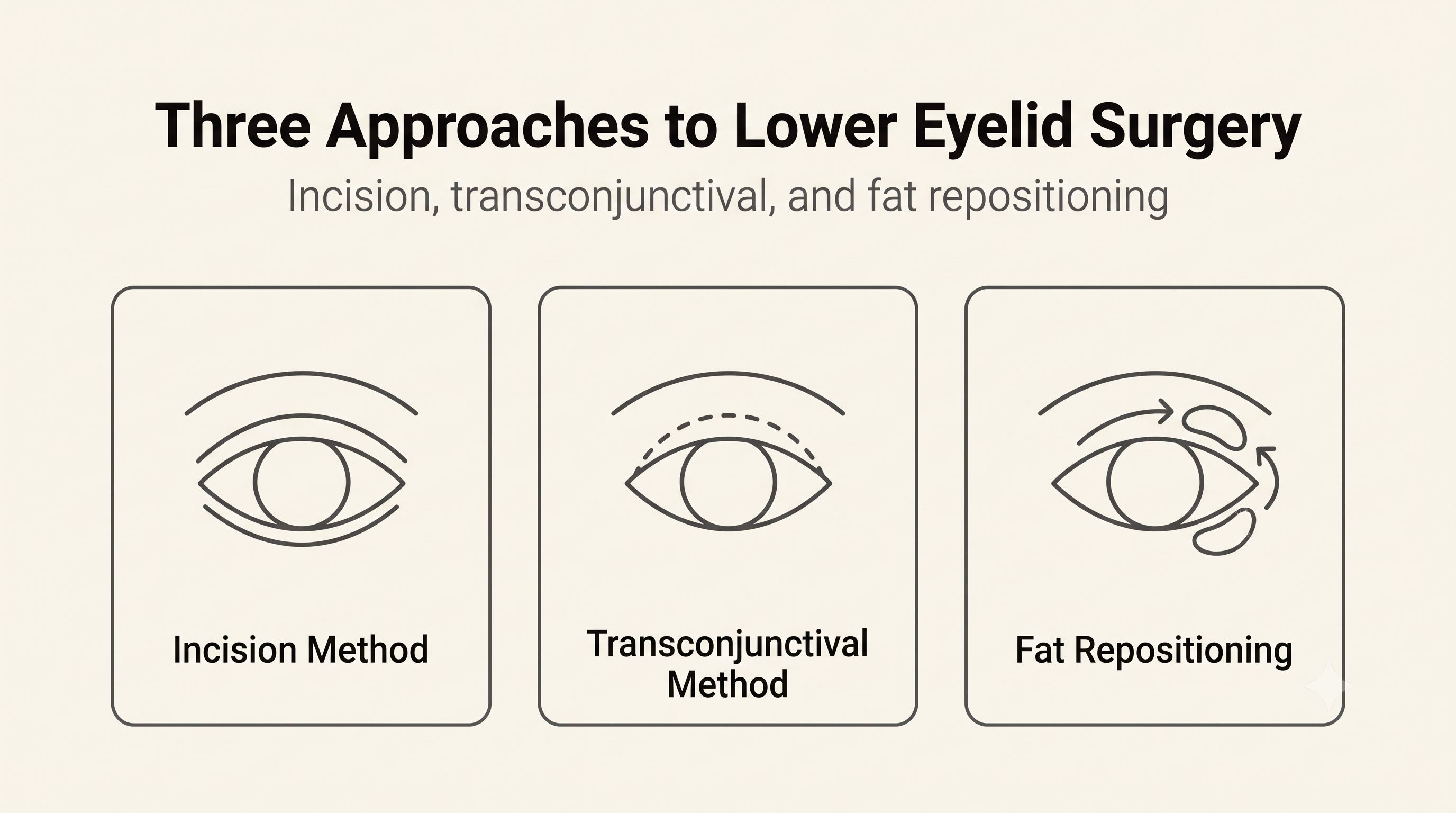
Lower blepharoplasty is broadly divided into three approaches. ①Incisional lower blepharoplasty involves an incision below the lash line to address sagging skin and muscle together; ②Transconjunctival lower blepharoplasty (conjunctival incision, TCR) accesses the area through the inner conjunctiva of the eye to adjust fat only; and ③Fat repositioning moves protruding fat to hollowed areas to restore volume, rather than removing it. All three share the goal of "correcting the lower eyelid," but they differ in scar location, recovery time, and who they suit best.
Why the Under-Eye Area Changes — 5 Signs That Prompt a Lower Blepharoplasty Consultation
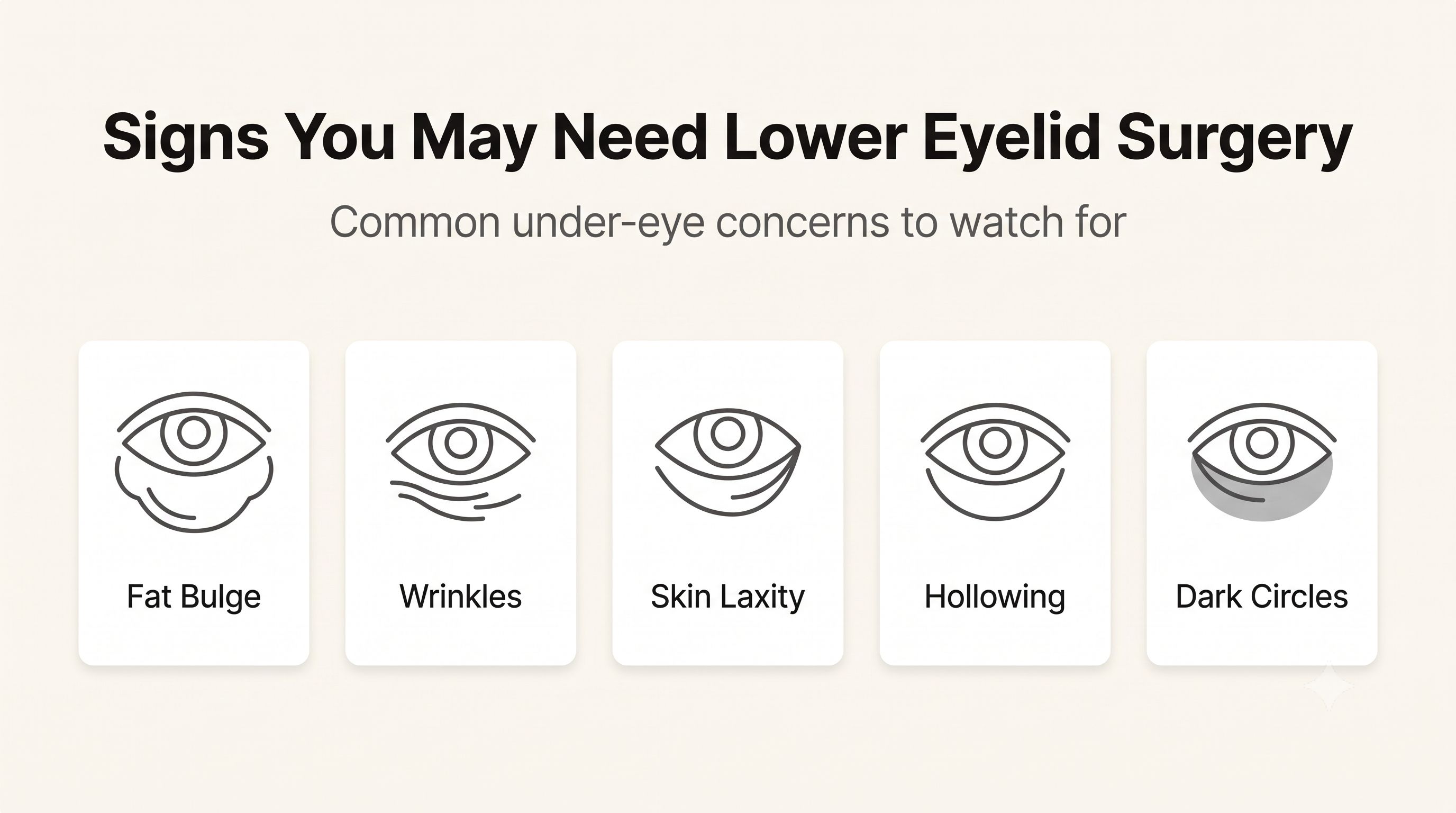
Changes under the eyes aren't caused by a single factor — they result from overlapping changes in fat, skin, volume, and pigmentation. Under-eye fat bulging occurs when orbital fat (the fat layer surrounding the eyeball) pushes forward against the thin skin membrane, commonly starting in one's 30s–40s. Under-eye fine lines are caused by declining elasticity in the skin itself. Under-eye skin laxity refers to more pronounced sagging, which — if left unaddressed — carries a risk of progressing to ectropion (the outward turning of the lower eyelid), so particular caution is needed from one's 50s–60s onward. Under-eye hollowing is the shadowed appearance caused by volume loss, and dark circles are divided into the shadow type (caused by fat and hollowing) and the pigmented type (caused by skin pigmentation). Which of these five is the underlying cause determines both the appropriate surgical approach and whether additional procedures are needed.
Source: Dr. Choi Dong-il, Gangnam Seoyon Plastic Surgery
Your Options — Incisional, Transconjunctival, and Fat Repositioning
All three approaches are selected after a specialist evaluates the degree of fat bulging, skin laxity, and volume loss. The table below summarizes the key differences.
| Comparison | Incisional Lower Blepharoplasty | Transconjunctival Lower Blepharoplasty (Conjunctival Incision, TCR) |
|---|---|---|
| Best For | Cases with significant skin laxity | Cases where fat bulging is the main issue with minimal skin laxity |
| Scarring | Incision line below the lash line (becomes less noticeable over time) | No external scar (accessed via the conjunctiva) |
| Recovery Time | Stitches removed at 5–7 days; many return to daily life within 1–2 weeks | Relatively faster recovery than the incisional method |
💡 Note
Fat repositioning is most often performed via the transconjunctival approach, and in many cases follows the same surgical pathway as the transconjunctival method described in the table above.
Incisional Lower Blepharoplasty
This approach is considered when both skin and muscle have sagged together. Because the incision is made just below the lash line, sagging skin can actually be trimmed and tightened, but this comes with the trade-off of a visible external scar. Scars often fade over time, but how much they fade and over what timeframe can vary depending on individual constitution and skin condition.
Transconjunctival Lower Blepharoplasty (Conjunctival Incision, TCR)
This is suitable when fat bulging is the main issue and skin laxity is not significant. Because the approach is made through the conjunctiva (the mucous membrane on the inside of the eyelid), no visible external scar remains. However, if skin laxity is also present, this method alone will not resolve the sagging.
Fat Repositioning
This method moves protruding fat to hollowed areas to restore volume, rather than removing it. Its advantage is that when fat bulging and under-eye hollowing occur together, a single procedure can address both — though if the skin itself is significantly lax, additional skin correction may be needed.
Upper vs. Lower Blepharoplasty
The upper eyelid and lower eyelid differ not only in location but in the problems they typically present, the age groups most commonly affected, and scar location. Lower eyelid issues tend to be more common in people in their 30s–60s, while upper eyelid drooping tends to be more common from the 40s–70s. If you feel a heavy, sagging sensation in the upper eyelid that obstructs your field of vision, the issue is more likely upper eyelid–related; if your concern is under-eye fat, fine lines, or hollowing, it's more likely a lower eyelid issue — and in some cases both areas are corrected together. An accurate distinction should be confirmed through an in-person consultation.
Source: Dr. Choi Dong-il, Gangnam Seoyon Plastic Surgery
👉 Want to learn more about transconjunctival lower blepharoplasty (TCR)? Check out Gangnam Seoyeon Plastic Surgery's under-eye fat repositioning (transconjunctival incision/TCR) page
Things to Consider — Risks, Scarring, and When This Surgery Isn't Right
Every surgical approach carries risk, and lower blepharoplasty is no exception.
🚨 Side Effects of Overcorrection to Watch For
If significant under-eye skin laxity is left untreated, or if the degree of correction is overdone, it can lead to eye irritation or ectropion — the outward turning of the lower eyelid. Before surgery, it's essential to discuss risk factors and post-operative precautions in detail with your surgeon.
Scar Differences by Approach
The incisional method leaves an incision line below the lash line that often becomes less noticeable over time, whereas the transconjunctival method leaves no external scar at all. That said, whether scar pigmentation or depression occurs, and how quickly it fades, can vary depending on the patient's constitution and skin condition.
Side Effects and Post-Operative Precautions
Dark circles caused by skin pigmentation are better addressed with laser or other skin treatments rather than surgery, and whether surgery is suitable depends on individual eye condition and the degree of skin laxity, as determined through a specialist's diagnosis. While there is no specific age limit, pre-operative testing may be more important for those with dry eye or certain eye conditions — a specialist should confirm ophthalmic and structural suitability before surgery, including the likelihood of eye irritation, ectropion, and whether dark circles are pigmentation-based.
When This Surgery Won't Help (Including Pigmented Dark Circles)
It's equally important to clearly identify cases where lower blepharoplasty is not the right fit. Dark circles caused by skin pigmentation are not improved by lower blepharoplasty — laser or other skin treatments are the appropriate approach instead. If changes under the eyes are minor and don't interfere with daily life, watchful monitoring may be preferable to surgery. Additionally, upper eyelid problems such as drooping eyelids should be corrected separately with upper blepharoplasty or eyelid-crease surgery, not lower blepharoplasty.
Source: Dr. Choi Dong-il, Gangnam Seoyon Plastic Surgery

Getting It Done in Korea — Cost, Recovery Time, and Number of Visits
In Korea's aesthetic surgery market, pricing structures for a given procedure are often disclosed differently from clinic to clinic, so the first thing to check when comparing options is what's actually included in the quoted rate. Gangnam Seoyeon Plastic Surgery publishes its procedure rates through the SafeDoc platform: under-eye fat repositioning (transconjunctival incision/TCR) is priced at ₩2,530,000, while a combined midface lift and under-eye fat grafting procedure is priced at ₩4,400,000. Having rates disclosed upfront like this is genuinely useful when comparing options, since it lets you gauge your budget before even booking a consultation. That said, the final cost can vary based on individual condition and any procedures performed together, so it should be confirmed through consultation.
SafeDoc Rate Comparison: Under-Eye Fat Repositioning (TCR) vs. Midface Lift + Fat Grafting
| Procedure | SafeDoc Rate | Approach |
|---|---|---|
| Under-eye fat repositioning (transconjunctival incision/TCR) | ₩2,530,000 | Fat repositioning via the conjunctiva, no external scar |
| Midface lift + under-eye fat grafting | ₩4,400,000 | Combines lifting with volume restoration |
The two procedures serve different purposes. TCR focuses purely on fat repositioning, while the midface lift + fat grafting combination also lifts sagging tissue while restoring volume — which accounts for the price difference. Which one is right for you depends on the degree of skin laxity you have, so it's worth comparing your own condition during a consultation.
Source: Dr. Choi Dong-il, Gangnam Seoyon Plastic Surgery
👉 Curious about a procedure that also addresses skin sagging? Check out the midface lift + under-eye fat grafting procedure details
Recovery Timeline: From Stitch Removal to Final Results
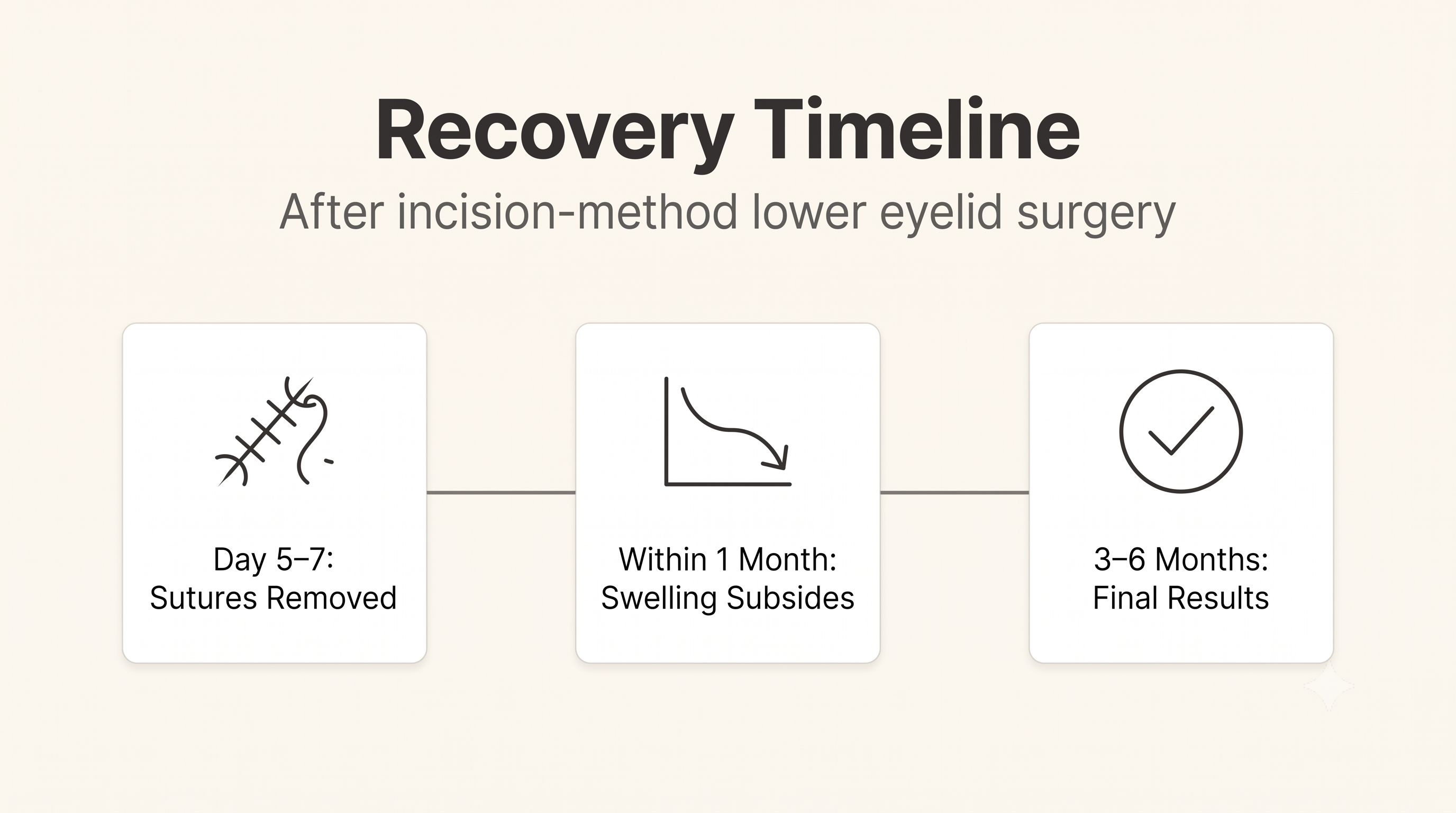
For incisional lower blepharoplasty, stitches are typically removed around 5–7 days after surgery, and many people can return to daily activities within 1–2 weeks after that. 70–80% of swelling subsides within 1 month, but the final contour of the under-eye area can't be assessed until 3–6 months have passed. Recovery timelines for the transconjunctival method or fat repositioning performed on their own may differ from the incisional method, and recovery speed can vary based on individual skin elasticity, degree of swelling, and aftercare — so it's a good idea to confirm your expected timeline in detail during consultation.
Preparation for International Patients
If you're traveling to Korea from abroad to consider this surgery, calculating the number of visits and length of stay in advance is important for planning your schedule. From initial consultation through surgery day, stitch removal, and follow-up, the number of required visits is generally 2–3 visits (initial consultation and surgery day, plus — if the incisional method is performed — stitch removal and follow-up around 5–7 days later), and the recommended length of stay is around 3–5 days for transconjunctival fat repositioning, and around 5–7 days for lower blepharoplasty requiring stitch removal. Pre-operative testing items and any medications that need to be discontinued require a prior specialist diagnosis of your under-eye fat bulging, skin laxity, and volume loss, along with a review of your individual medication history; whether English-language or other foreign-language consultation and materials are available can be confirmed in advance through the SafeDoc global platform and the clinic's intake process. It's recommended that these details be finalized with a coordinator before booking.
Source: Dr. Choi Dong-il, Gangnam Seoyon Plastic Surgery
❓ Frequently Asked Questions (FAQ)
Q1: Are lower blepharoplasty and fat repositioning the same thing?
Fat repositioning is one type of lower blepharoplasty. Lower blepharoplasty is the umbrella term for correcting the lower eyelid, and depending on the approach, it's divided into incisional, transconjunctival, and fat repositioning methods. Based on the transconjunctival method (TCR), SafeDoc's published rate is ₩2,530,000.
Q2: Does lower blepharoplasty leave a scar?
It depends on the approach. The transconjunctival method has no external skin incision, so scarring is less of a concern, and while the incisional method does leave an incision line just below the lash line, it often blends naturally into the lash line over time. That said, how much scarring fades and over what timeframe can vary by individual constitution and skin condition.
Q3: How long is the recovery period after lower blepharoplasty?
With the incisional method, many people can return to daily life within 1–2 weeks after stitch removal. 70–80% of swelling subsides within 1 month, and the final result can be assessed after 3–6 months. The transconjunctival method involves no skin incision, so recovery is relatively faster.
Q4: Is there an age limit for lower blepharoplasty? Are there any side effects?
There is no specific age limit. Under-eye fat bulging can appear as early as one's 30s–40s, and worsening skin laxity can appear from the 50s–60s onward, so your current under-eye condition matters more than your age. However, overcorrection carries a risk of eye irritation and ectropion (outward turning of the lower eyelid), and dark circles caused solely by skin pigmentation are excluded as candidates for this surgery.
Q5: Can lower blepharoplasty improve dark circles too?
It depends on the cause. Shadow-type dark circles caused by fat bulging or hollowing may improve, but if the cause is skin pigmentation, a different approach such as laser treatment is needed. A pre-treatment diagnosis to determine the cause is essential.
Next Steps — From Consultation to Booking
Before finalizing which surgical approach to pursue, you'll need an in-person diagnosis of your under-eye condition. If you're considering lower blepharoplasty in Korea, using a platform like SafeDoc, where procedure rates are disclosed transparently in advance, has real practical advantages during the comparison stage — it lets you gauge a cost range before consultation and lets you identify who you'll be consulting with based on named specialist information. That said, evaluating any individual clinic's clinical capabilities or areas of specialization is separate from the general clinical information covered in this article; we recommend checking the separate provider page to review the care system and SafeDoc's transparent, pre-disclosed rates (such as ₩2,530,000 for the transconjunctival/TCR approach).
Source: Dr. Choi Dong-il, Gangnam Seoyon Plastic Surgery
Check Gangnam Seoyeon Plastic Surgery's Eye Surgery Page
Whether your under-eye condition matches a given technique needs to be confirmed through an in-person consultation. You can review the specialist in charge and available procedures on the detailed provider page for Gangnam Seoyeon Plastic Surgery, a clinic focused on eye surgery.
👉 Curious about the specialist in charge and available procedures? Check out the Gangnam Seoyeon Plastic Surgery provider page
Request a Consultation with a SafeDoc Coordinator
Details that are still unclear — such as number of visits, length of stay, and preparation steps — are best clarified through a consultation before booking.
👉 Want detailed guidance on your visit schedule and preparation? Reach out to a SafeDoc coordinator on WhatsApp