Eye Fat Repositioning Cost in Korea: Recovery & Side Effects
Published: September 14, 2026 · Last updated: September 14, 2026
💡 Key Takeaways at a Glance
- How it's done: The surgeon works through the inner conjunctiva to remove or reposition protruding fat, leaving virtually no visible scarring.
- Procedure time & recovery: About 30 minutes, with same-day discharge; recovery is generally described as starting from day 1.
- Cost: About KRW 2,800,000 based on SafeDoc's listed pricing, though this can vary by clinic and individual case.
🎯 Who this guide is for: Anyone who wants to improve the look of protruding under-eye fat and dark-circle-like shadows, and who wants to understand the cost, recovery time, and side effects of having this done in Korea.
What Is Under-Eye Fat Repositioning? For Those Concerned About Dark Circles or Puffiness
Under-eye fat repositioning is a procedure designed to improve the appearance of prominent under-eye fat that can develop with age or due to individual constitution, making the eyes look like they have dark circles or a tired expression. Because the surgeon works through the conjunctiva (the inner lining of the eyelid), no incision is left on the visible skin. The protruding fat is either removed or shifted into hollow areas to smooth out the under-eye contour. The surgery is performed under sedation (twilight anesthesia) or local anesthesia and takes about 30 minutes, with same-day discharge and no hospital stay required. Another notable feature is that the conjunctiva is closed with dissolvable stitches, so there is no need to return to the clinic to have stitches removed.
This procedure is generally described as suitable for people whose main concern is the protruding fat itself rather than the skin, and whose skin elasticity is relatively good. On the other hand, if the skin is significantly sagging along with wrinkles and looseness, this procedure alone may offer limited improvement, so it's worth reviewing the alternatives covered elsewhere in this guide.
Problems Under-Eye Fat Repositioning Addresses
- Shadowing from under-eye fat protrusion that looks like dark circles
- A tired or aged appearance
- Uneven contours along the under-eye line
Who This Procedure May Be Right For
- Those whose main concern is under-eye fat protrusion, with relatively good skin elasticity
- Those who want minimal scarring and a short recovery period
- Whether this procedure is truly right for you needs to be confirmed through an in-person consultation and diagnosis.
Why Does Under-Eye Fat Protrude? Causes and How to Tell
There is a layer of fat beneath the eyes that helps cushion and protect the eyeball, held in place by a thin membrane called the orbital septum (the membrane that keeps fat tucked inside the eye socket). As we age, this membrane can weaken or stretch, allowing the fat behind it to push forward, which makes the under-eye area look puffy or bulging. People who are genetically predisposed to a thicker fat layer, or whose skin and muscle elasticity is relatively weak, can develop this bulging even at a young age. Lifestyle factors such as lack of sleep or frequently rubbing the eyes are mentioned as things that can make puffiness and shadows more noticeable, but they are not considered the underlying cause of the fat protrusion itself.
What Causes Under-Eye Fat Protrusion
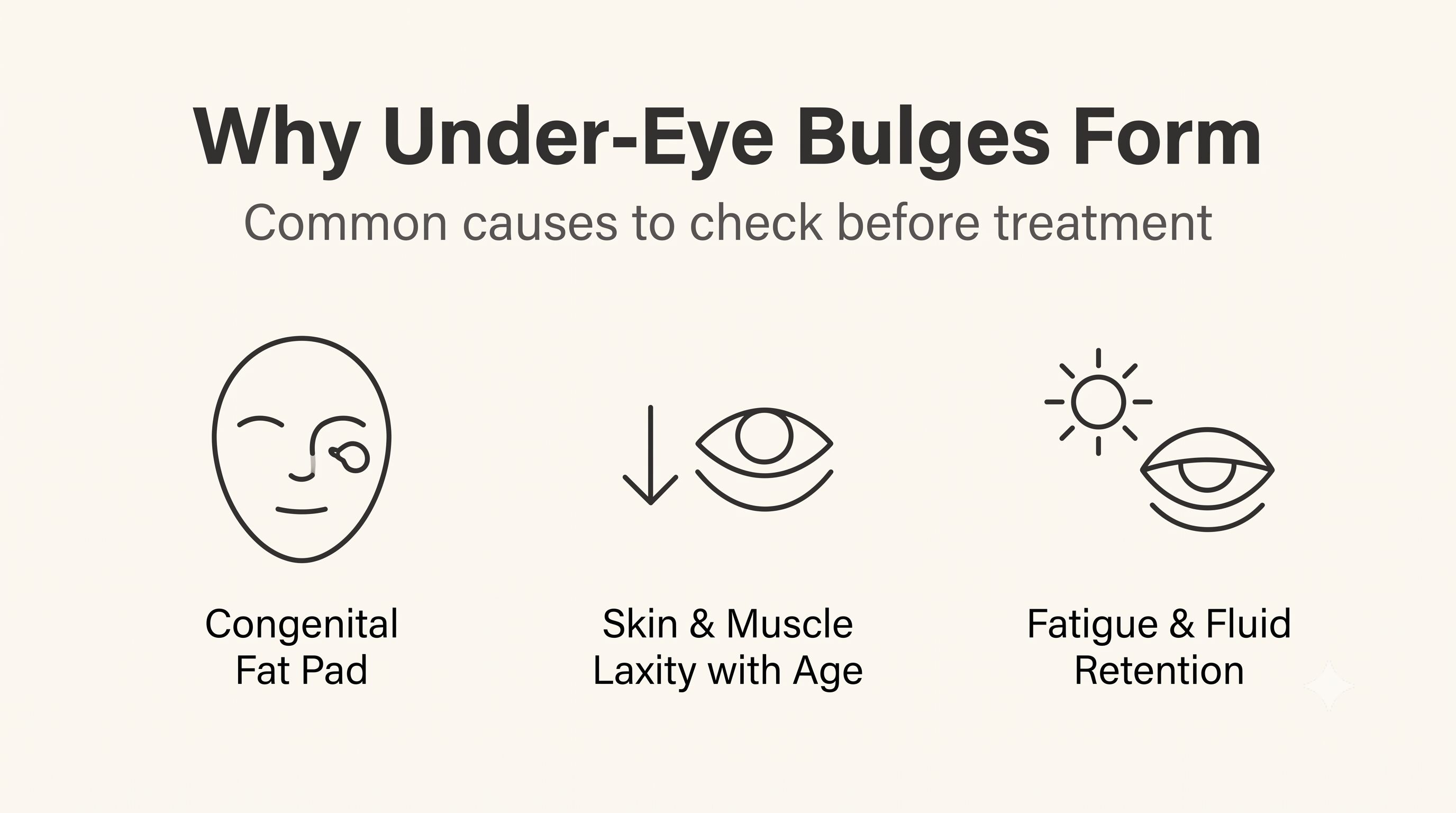
- Weakening of the orbital septum due to aging
- A naturally thicker fat layer (constitutional)
- Reduced elasticity of the skin and muscle
How to Decide Whether Surgery Is Necessary
- When non-surgical care such as massage or fillers has not led to improvement
- When the fat protrusion is clearly visible or can be felt
- The final decision should be made through a consultation with a specialist.
What Are the Options for Under-Eye Fat Repositioning?
Approaches to addressing under-eye fat generally fall into two main categories: transconjunctival fat repositioning, which involves an incision inside the conjunctiva, and lower blepharoplasty, which involves a skin incision. Non-surgical options such as fillers and laser treatments are also mentioned as alternatives.
Transconjunctival Fat Repositioning (Incision Inside the Eyelid)
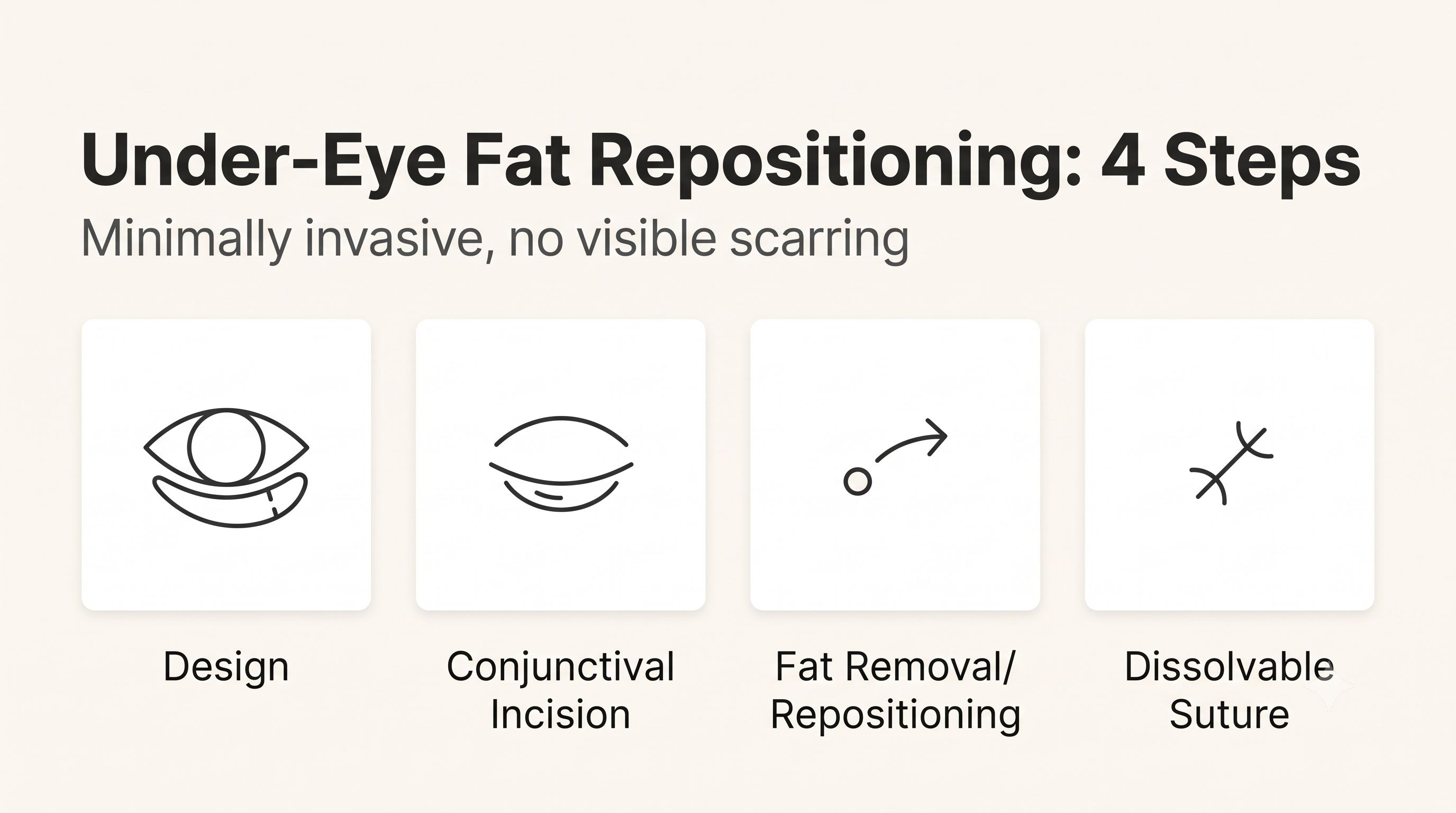
Transconjunctival fat repositioning is carried out in four steps: ① designing the extent and shape of the fat to be treated, ② making a minimal incision inside the conjunctiva, ③ removing the fat or moving it to where it's needed, and ④ stopping any bleeding and closing the incision with dissolvable stitches. Because there is no skin incision, scarring is barely visible from the outside, and recovery tends to be relatively short.
- Design — assessing the extent and shape of the fat
- Conjunctival incision — a minimal incision inside the eyelid
- Fat removal/repositioning — adjusting unnecessary fat
- Closure — stopping bleeding and closing with dissolvable stitches
Lower Blepharoplasty (Skin Incision) and Other Alternatives
Because lower blepharoplasty addresses the skin and muscle as well as the fat, it is considered an option when skin sagging accompanies the fat protrusion, not just fat protrusion on its own. Details such as incision placement and recovery time vary depending on the specific technique used.

| Category | Under-Eye Fat Repositioning (Transconjunctival) | Lower Blepharoplasty (Skin Incision) |
|---|---|---|
| Incision location | Inside the conjunctiva | An incision is made just below the lash line to address sagging skin and protruding fat together |
| Scarring | Barely visible from the outside | A fine incision line remains just below the lash line, but it gradually fades over time and becomes nearly unnoticeable |
| Procedure time | About 30 minutes | About 30 minutes to 1 hour |
| Stitch removal | Not needed (dissolvable stitches) | Required (stitches removed around day 5–7 after surgery) |
| Recovery time | From day 1 onward (as commonly advised) | About 1–2 weeks (swelling and bruising gradually subside after the stitches are removed) |
| Suitable for | Mainly fat protrusion, with good skin elasticity | Effective when skin elasticity has declined significantly, with pronounced wrinkles and sagging |
How This Differs From Non-Surgical Care
Non-surgical options such as fillers and lasers can offer a temporary improvement by adding volume or refining the surface of the skin, but they cannot remove the protruding fat itself. Each alternative has its own specific application: fillers are used to fill in hollow areas under the eyes, lasers are used to improve fine surface wrinkles and skin elasticity, and lower blepharoplasty is applied to middle-aged and older patients with significant skin laxity and protruding under-eye fat.
👉 Curious about regenerative-medicine-based anti-aging approaches? Check out our stem cell anti-aging guide!
Things to Consider: Risks, Side Effects, Limitations, and Who Should Avoid It
🚨 The Following Individuals Must Consult a Specialist Before This Procedure
This procedure may not be suitable for those with a history of eye disease, those currently taking blood-related medications such as anticoagulants, or those whose skin elasticity has declined so much that a conjunctival incision alone would not achieve improvement.
Like any surgery, under-eye fat repositioning carries potential risks, including bleeding, infection, left-right asymmetry, and hollowing under the eyes if too much fat is removed. These risks vary depending on an individual's health status and the extent of the surgery, and are described as being largely preventable through careful, individualized design and a tailored surgical approach. It is safest to avoid absolute claims such as "no" scarring at all or "no" side effects whatsoever, and to keep in mind that individual results can vary.
Possible Side Effects
- Bleeding, bruising, swelling, dry eyes, hollowing under the eyes from excessive fat removal, left-right asymmetry, and (in the case of lower blepharoplasty) ectropion, a condition where the eyelid turns slightly outward
- Recovery speed and results can vary depending on individual condition.
When This Procedure May Not Be Suitable
- Those with severe dry eye syndrome, conjunctivitis, or other eye conditions
- Those currently taking blood-thinning anticoagulants (medication adjustment is needed beforehand)
- Those who have recently had eye surgery or have difficulty controlling bleeding
Limitations of This Procedure
- If significant skin sagging is also present, the improvement from this procedure alone may be limited, and lower blepharoplasty may need to be considered alongside it.
- This procedure is not suitable when under-eye skin sagging is so severe that a conjunctival incision alone cannot improve the wrinkles, or when there is a high risk of the eyelid turning outward after surgery.
Getting It Done in Korea: Cost, Timeline, Visits, and Recovery
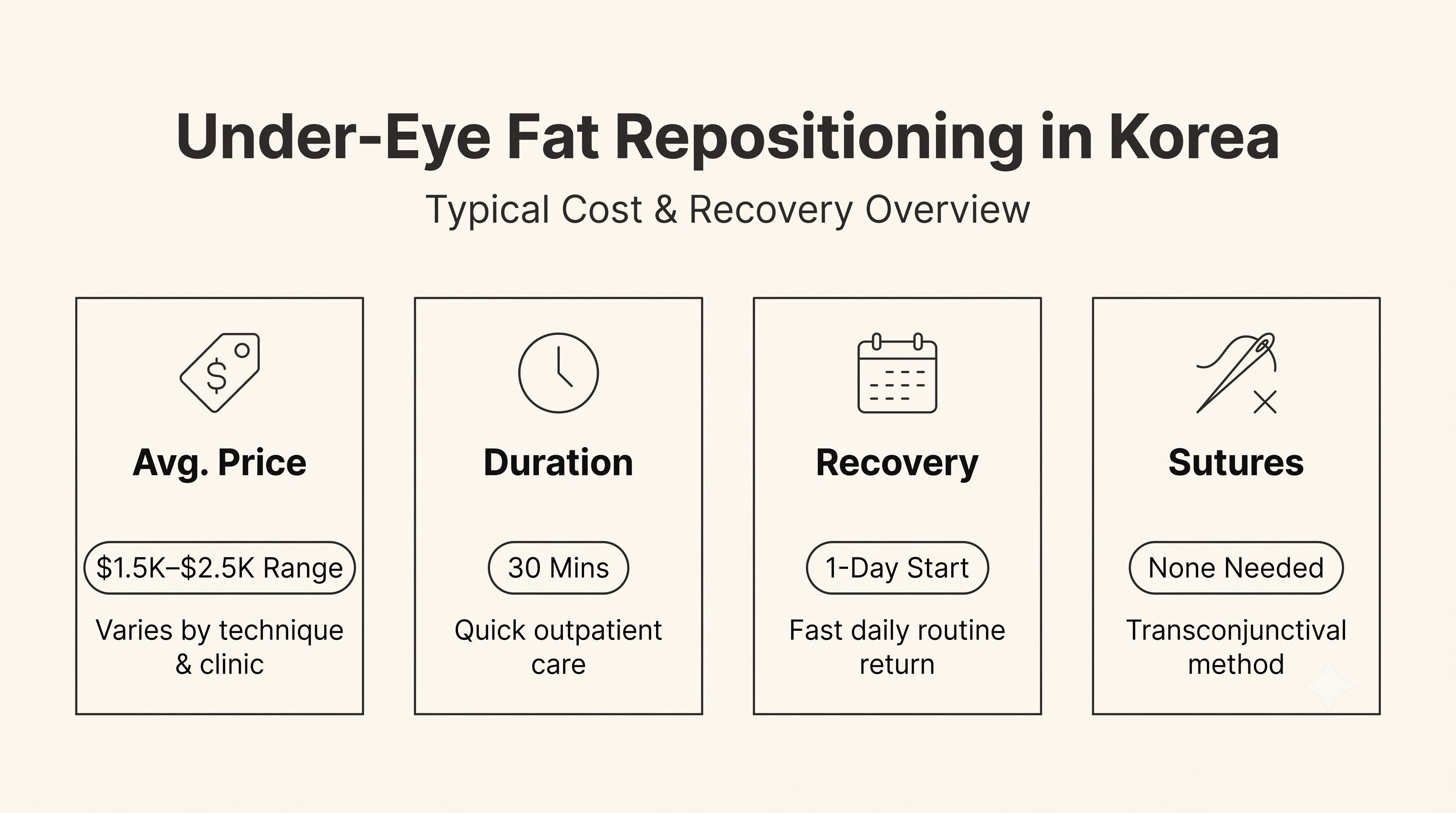
If you have under-eye fat repositioning done in Korea, the cost based on SafeDoc's partner pricing is about KRW 2,800,000. The procedure takes around 30 minutes, is performed under sedation or local anesthesia, and allows for same-day discharge. Because the conjunctiva is closed with dissolvable stitches, there is no separate stitch-removal step, and recovery is described as starting from day 1. That said, this figure is a reference price, and the actual cost can vary depending on the clinic and the individual's fat volume and scope of the procedure.
| Item | Details |
|---|---|
| Cost | About KRW 2,800,000. Depending on the individual's eye condition (whether additional procedures such as lower blepharoplasty, fat grafting, or septal reinforcement are included) and the complexity of the surgery, the cost can range from roughly KRW 2,000,000 to KRW 4,000,000. |
| Procedure time | About 30 minutes |
| Anesthesia method | Sedation (twilight anesthesia) or local anesthesia |
| Hospital stay | Same-day discharge |
| Stitch removal | Not needed (dissolvable stitches) |
| Recovery time | From day 1 onward (as commonly advised). Major swelling generally subsides within 1–2 weeks, and it takes about 2–4 weeks for bruising and residual swelling to fully disappear. |
| Total number of visits | A total of 2–3 visits (1st: consultation and surgery / 2nd: disinfection and follow-up check / 3rd: stitch removal, for lower blepharoplasty) |
| Recommended stay for international patients | A stay of about 3–5 days is recommended for transconjunctival fat repositioning, and about 5–7 days for lower blepharoplasty, which requires stitch removal. |
| Pre-procedure preparation | Photo-based pre-consultation and medication review, anesthesia guidance (fasting before surgery), and an in-person examination after scheduling an appointment |
| Foreign-language consultation | One-on-one English and other foreign-language consultations, as well as medical interpretation services, are available through a dedicated coordinator |
💡 Note
The price above is based on SafeDoc's listed rate. The actual cost is confirmed individually through a consultation with the clinic.
❓ Frequently Asked Questions (FAQ)
Q1: How long does under-eye fat repositioning surgery take?
The procedure takes about 30 minutes and is performed under sedation or local anesthesia, allowing for same-day discharge.
- Procedure time: about 30 minutes
- Anesthesia method: sedation/local anesthesia
- Hospital stay: same-day discharge
Q2: How long is the recovery period, and when are stitches removed?
Because the conjunctiva is closed with dissolvable stitches, there is no stitch-removal step, and recovery is generally described as possible from day 1 onward, though the time for swelling to fully disappear varies by individual.
- Stitch removal: not needed (dissolvable stitches)
- Recovery time: from day 1 onward (as commonly advised)
- Time for swelling/bruising to fully disappear: varies by individual constitution, but is generally around 2–4 weeks
Q3: Are there any side effects or risks with under-eye fat repositioning?
As with any surgery, there can be risks such as bleeding, infection, and left-right asymmetry, and these can vary depending on individual condition.
- Possible side effects: bleeding, bruising, swelling, dry eyes, hollowing under the eyes from excessive fat removal, left-right asymmetry, and (for lower blepharoplasty) ectropion
- Not recommended for: those with severe eye disease, those taking medications that interfere with blood clotting, and those whose skin sagging is too severe to be improved by a conjunctival incision alone
Q4: How much does under-eye fat repositioning cost in Korea?
Based on SafeDoc's partner pricing, it costs about KRW 2,800,000, though this can vary depending on the clinic and individual case.
- Cost: about KRW 2,800,000
- Price variation by clinic: depending on whether additional procedures (such as septal reinforcement or fat grafting) are included and on the individual case, the cost can range from roughly KRW 2,000,000 to KRW 4,000,000
Q5: How is under-eye fat repositioning different from lower blepharoplasty (under-eye skin excision)?
Under-eye fat repositioning uses an incision inside the conjunctiva, so it leaves almost no visible scarring, but if skin sagging is severe, lower blepharoplasty, which removes excess skin, may be considered instead.
- Under-eye fat repositioning: conjunctival incision, almost no visible scarring
- Suitable for lower blepharoplasty: those with both under-eye skin sagging and deep wrinkles
- Recovery time for lower blepharoplasty: about 1–2 weeks (stitches removed on day 5–7)
Next Steps: From Consultation to Procedure
If you're considering under-eye fat repositioning, the first step is a consultation that evaluates both the state of your under-eye fat and your skin elasticity. During the consultation, the degree of fat protrusion, skin elasticity, any history of eye disease, and current medications will be reviewed, and based on this, it can be determined whether transconjunctival fat repositioning is suitable or whether a different approach is needed.
What to Prepare for Your Consultation
- Recent photos that clearly show the condition of your under-eye area
- A list of medications you're taking, especially whether you're on any anticoagulants
- Any history of eye disease
- Detailed examination steps: photo-based pre-consultation and medication review, anesthesia guidance (fasting before surgery), and an in-person examination after scheduling an appointment
Related Clinic Information and Contact Channels
Detailed information about clinics that perform under-eye fat repositioning is available on SafeDoc's partner clinic pages. You can find more details about the surgery and clinics covered in this article on the SafeDoc treatment information page. For consultations about dermatology and plastic surgery procedures, including under-eye fat repositioning, you can reach out through the SafeDoc consultation channel.