
Dental Crown, Inlay and Composite Resin Filling Costs in Korea: Prices by Material and Number of Visits
Published: 2026-11-18
Dental crowns, inlays and composite resin fillings are restorative treatments that fill or cover a natural tooth damaged by decay or a fracture so that you can keep using it instead of having it pulled out. This guide covers, in order, what patients from abroad looking into dental treatment in Korea often check: prices by material, how many times you need to visit the dentist for each tooth and therefore how many days to stay in Korea, and the risks and limitations to know before treatment.
💡 Quick Summary: At a Glance
- Cost (per tooth): Based on the SafeDoc price (as of 2026-11-04) at 3 partner clinics, a composite resin filling costs ₩50,000–₩100,000 (one clinic says up to about ₩500,000 depending on the extent), a ceramic inlay ₩350,000–₩400,000, a gold inlay (molar) ₩590,000, a gold crown ₩900,000–₩1,000,000, a zirconia crown ₩400,000–₩800,000 and a PFM (porcelain-fused-to-metal) crown ₩550,000–₩600,000. If root canal treatment is needed, ₩600,000 (front tooth)–₩1,000,000 (molar) per visit is added at one clinic, and a post and core is also charged separately.
- Number of visits: A composite resin filling is usually finished in one visit, and inlays and crowns usually take 2 visits to the dentist (one partner clinic says 2–3 visits for crowns). This partner clinic recommends that patients from abroad stay in Korea for 5–7 days for inlays and 7–10 days for crowns.
- Check first: If you have active gum disease, find it hard to keep your mouth clean, get cavities often, clench or grind your teeth, or are young, a crown may not be right for you, so you should consult the dentist first. If you are pregnant or breastfeeding, the FDA (US Food and Drug Administration) recommends avoiding amalgam when possible. Sensitivity for 1–2 weeks after treatment is common, but if throbbing pain continues, you may need root canal treatment.
- Making them last: Guidance says crowns can usually last 5–15 years depending on care and fillings 10–20 years depending on the material, and they are not a permanent treatment.
🎯 Who This Guide Is For: People living outside Korea who are deciding whether to have cavity treatment, inlays or crowns in Korea and want to compare costs by material, the number of visits and length of stay before planning.
What Are Dental Crowns, Inlays and Composite Resin Fillings in Korea, and Who Are They For?
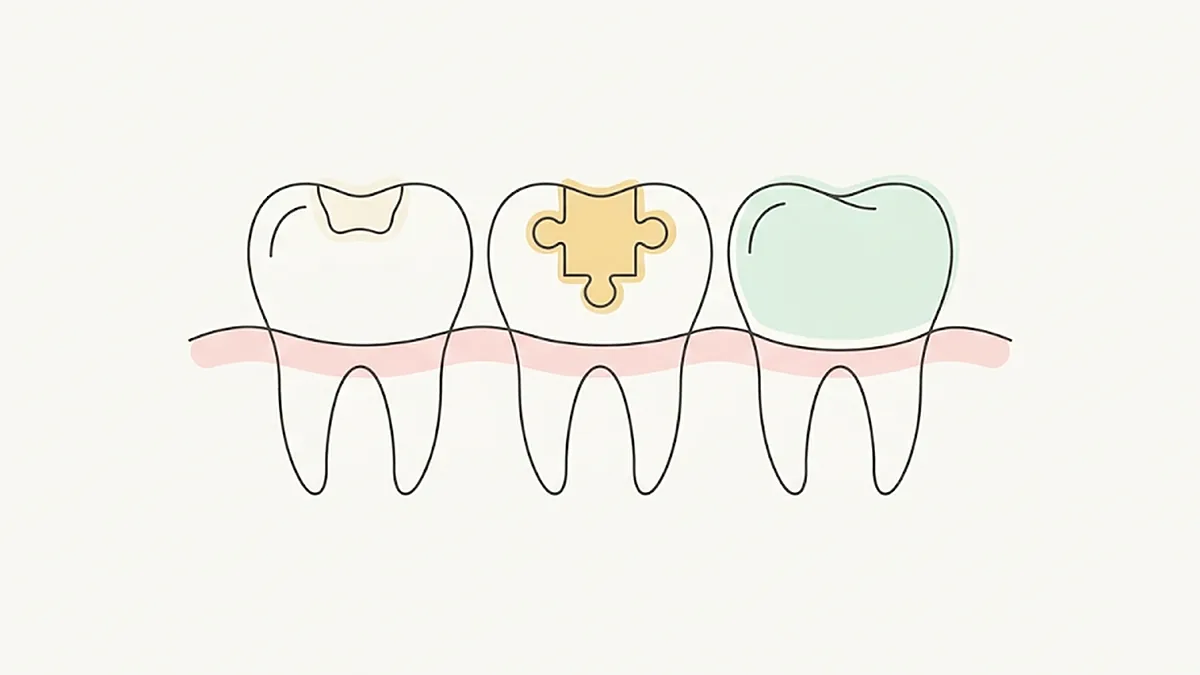
Dental restorative treatment restores the shape and chewing function of a tooth by refilling or covering, with a material, the area where decay was removed or a part that has broken. Depending on the extent of damage, it is divided into composite resin fillings, inlays and crowns, and the goal is to keep as much of the natural tooth as possible. A composite resin filling places tooth-colored material directly into the decayed area and hardens it, treating a relatively small cavity in one visit. An inlay involves taking an impression of the area where decay was removed, then fitting and bonding in a ceramic or gold piece made in a dental lab, and Cleveland Clinic in the US explains that inlays and onlays are used when the damage is too large for a filling but not large enough for a crown. A crown involves filing down the whole tooth and covering it like a cap, and it is used to strengthen a weakened tooth, protect a cracked tooth, restore a worn or broken tooth, or cover a tooth that has had root canal treatment. On the other hand, Leeds Teaching Hospitals says a crown may not be right for a tooth with little damage, and Cleveland Clinic explains that if nerve damage is severe, the tooth may need to be extracted. If the tooth is extracted, other treatment to fill the gap is considered separately. Which treatment is right for you is decided after an in-person examination and X-rays to check how deep the decay is, how much of the tooth remains and the condition of the nerve.
How Is the Treatment You Need Decided? Extent of Damage and Nerve Condition
Two factors decide the type of treatment: the extent of damage and the condition of the nerve. If the cavity is small, it can be treated in one visit with a direct filling that places tooth-colored composite resin straight into the tooth; if the damage is too large for a filling to support but not large enough for a crown, an inlay is considered; and if the tooth is cracked, badly broken or weakened, a crown is considered. Cleveland Clinic explains that once decay reaches the nerve inside the tooth (the pulp), a filling alone will not solve the problem; in that case root canal treatment is considered first, and a tooth that has had root canal treatment is sometimes covered with a crown. Leeds Teaching Hospitals says a post and core is sometimes used to rebuild a badly broken tooth after root canal treatment. In this case, the number of dental visits and the time you stay in Korea increase. Symptoms after treatment also tell you about the condition of the nerve. Cleveland Clinic explains that mild sensitivity and gum pain after a filling usually go away within 1–2 weeks, but a throbbing toothache can be a sign that decay has reached the nerve, so root canal treatment may be needed, and if pain with hot or cold things lasts a long time, nerve damage may mean that root canal treatment or extraction is needed. So if you are treated abroad, it is safer to leave a few days in your schedule after treatment to watch for symptoms.
Comparing Options by Material: Composite Resin, Ceramic, Gold, Zirconia and PFM
Materials differ in strength, color, how much of the tooth is filed down and cost, so they are chosen to suit the tooth's position and chewing force. A composite resin filling is a direct filling that places tooth-colored material straight into the tooth and is finished in one visit, and if the damage is too large for a filling to support, an inlay made in a dental lab is used. Inlay materials include tooth-colored ceramic (porcelain) and gold, which shows its gold color, and inlays usually take two visits, one for the impression and one for bonding. For crowns, Cleveland Clinic explains that metal crowns such as gold rarely break and last the longest in terms of wear, but because the metal color shows, they suit molars that are less visible. PFM crowns, which have porcelain fused over metal, combine a natural color with the strength of metal, but if the porcelain chips, the metal can show, and they can wear down the opposing teeth. Cleveland Clinic explains that all-ceramic crowns, including zirconia, give the most natural color and can be used even if you have a metal allergy, and that zirconia is very hard yet causes little wear on the opposing teeth. However, ceramic crowns with a layer of porcelain on top can chip over time, and Leeds Teaching Hospitals says all-ceramic crowns are used on visible teeth that do not take heavy chewing force. Leeds Teaching Hospitals says porcelain veneers (laminates), which require filing down less of the tooth than a crown, may be right for front teeth that do not take heavy chewing force. Color and translucency matter more for front teeth, and strength to withstand chewing force matters more for molars, so even for the same person, the material can differ depending on the tooth's position.
| Material or method | Advantages | Disadvantages | Mainly used for |
|---|---|---|---|
| Composite resin (direct filling) | Tooth-colored, one visit | If the damage is too large for a filling to support, an inlay or crown is considered | Small cavities |
| Ceramic inlay | Tooth-colored, fitted into the damaged area only | Usually 2 visits for the impression and fabrication | Damage too large for a filling but not large enough for a crown |
| Gold inlay | Fitted into the damaged area only | Gold color shows, usually 2 visits | Damage too large for a filling but not large enough for a crown |
| Metal (gold) crown | Rarely breaks and lasts the longest in terms of wear, requires filing down only a little of the tooth | Metal color shows | Less visible molars |
| PFM crown | Natural color and the strength of metal | Metal can show if the porcelain chips, wear on opposing teeth | Front teeth and molars |
| Zirconia or all-ceramic crown | Most natural color, possible even with a metal allergy, zirconia is hard and causes little wear on opposing teeth | Ceramics with a porcelain layer can chip, Leeds Teaching Hospitals says all-ceramic crowns are used where chewing force is not heavy | Front teeth and molars |
👉 If your goal is to change the color or shape of your front teeth, there are options other than crowns. Learn about front-tooth veneer (laminate) costs in Korea by type and how to choose
Considerations: Risks, Side Effects, Limitations and Who Should Not Have Them
Restorative treatment helps save teeth, but it has risks and limitations. Cleveland Clinic explains that fitting a crown requires filing down the outer surface of the tooth (enamel), that sensitivity to hot or cold is common for about 2 weeks after treatment, and that crowns can chip or break over time. If a crown does not fit well, bacteria can get trapped in the gap and cause new decay, allergic reactions to the material occur rarely, and you should contact the dentist if the crown is loose, cracked or broken, or if you notice bad breath, an unpleasant taste or a sharp edge. After a filling as well, sensitivity and gum pain can last 1–2 weeks, and throbbing pain or long-lasting sensitivity can be a sign that root canal treatment is needed. Cleveland Clinic explains that the American Dental Association (ADA) and the FDA consider silver amalgam safe, but the FDA recommends that some people, such as pregnant women and young children, avoid it when possible. The UK's Leeds Teaching Hospitals says a crown may not be right if you have poor oral hygiene, get cavities often, have active gum disease, clench or grind your teeth, have a tooth with little damage, or are young. A crown usually lasts 5–15 years depending on care (8–10 years according to Leeds Teaching Hospitals), and it may need to be remade over time.
⚠️ When You Must Tell the Clinic Before Treatment
- If you have active gum disease, find it hard to keep your mouth clean, get cavities often or are young, a crown may not be right for you (Leeds Teaching Hospitals), so tell the clinic before treatment.
- If you clench or grind your teeth, a crown may not be right for you (Leeds Teaching Hospitals), so tell the clinic in advance, and if you do have a crown, discuss a custom mouthguard (Cleveland Clinic).
- If you are pregnant or breastfeeding, or are planning a pregnancy within 1 year, you are among those the FDA recommends avoid amalgam when possible, so tell the clinic before treatment.
- If you have a metal allergy, tell the clinic in advance so that you can choose a metal-free material.
- A tooth with throbbing pain or long-lasting sensitivity, or a tooth that has already had root canal treatment, may need root canal treatment or a post, which would change the schedule and cost, so tell the clinic in advance.
| Risk or limitation | Details |
|---|---|
| Sensitivity | Common for 1–2 weeks after a filling or crown; if it lasts, have the nerve checked |
| Gum pain | Usually goes away within a few days after a crown and within 1–2 weeks after a filling |
| Nerve problems | Throbbing pain or long-lasting sensitivity → root canal treatment or extraction may be needed |
| Chipping or loosening | Crowns can chip or become loose over time; with PFM, the metal shows if the porcelain chips |
| Secondary decay | If a crown does not fit well, decay can develop in the gap |
| Allergy | Rare. With a metal allergy, use a metal-free material |
| Lifespan | Crowns 5–15 years (Leeds Teaching Hospitals: 8–10 years), fillings 10–20 years depending on the material |
👉 If you have been told your tooth is hard to save, get to know the next option as well. Learn about dental implant costs, treatment time and number of visits in Korea
If You Get Treated in Korea: Cost by Material, Number of Visits and Length of Stay
The cost of dental restorative treatment in Korea depends on the material, the tooth's position and the clinic. Based on the SafeDoc price (as of 2026-11-04, per tooth) at 3 partner clinics, a composite resin filling costs ₩50,000 (about $34) for a molar at Clinic A, ₩80,000 (about $55) for a molar at Clinic C and ₩100,000 (about $69) at Clinic B, and Clinic B says it can rise to about ₩500,000 (about $345) depending on the extent. A ceramic inlay costs ₩350,000 (about $241) at Clinics A and C and ₩400,000 (about $276) at Clinic B, and a gold inlay costs ₩590,000 (about $407) for a molar at Clinic C. For crowns, zirconia costs ₩400,000–₩800,000 (about $276–$552) depending on the clinic and the tooth's position, PFM ₩550,000–₩600,000 (about $379–$414) at Clinic B, and gold ₩900,000 (about $621) for a molar at Clinic C and ₩1,000,000 (about $690) at Clinic B, while Clinic C's all-ceramic crown for a front tooth costs ₩700,000 (about $483). If a post and core is placed, a resin core at ₩100,000 (about $69) and a post at ₩150,000 (about $103) are added at Clinic B, and root canal treatment is charged separately for each visit. On the platform, what is included is shown only as "consultation" (Clinic C: "treatment and consultation"), so when you get a quote, also check X-ray and examination fees, the temporary crown, whether root canal treatment is needed and its cost, and the conditions for remaking.
Cost Range Table
| Treatment | Clinic A (KRW) | Clinic B (KRW) | Clinic C (KRW) | Approx. USD (full range) |
|---|---|---|---|---|
| Composite resin filling (1 tooth) | ₩50,000 (molar) | ₩100,000 (up to about ₩500,000 depending on the extent) | ₩80,000 (molar) | $34–$345 |
| Ceramic inlay | ₩350,000 (Lava) | ₩400,000 | ₩350,000 (e.max) | $241–$276 |
| Gold inlay | — | — | ₩590,000 (molar) | $407 |
| Gold crown | — | ₩1,000,000 | ₩900,000 (molar) | $621–$690 |
| Zirconia crown | ₩400,000 (molar) | ₩650,000 (molar)–₩800,000 (front tooth) | ₩600,000 (molar)–₩650,000 (front tooth) | $276–$552 |
| All-ceramic crown (front tooth) | — | — | ₩700,000 | $483 |
| PFM crown | — | ₩550,000 (molar)–₩600,000 (front tooth) | — | $379–$414 |
| Post and core (resin core, post) | — | ₩100,000–₩150,000 | — | $69–$103 |
| Root canal treatment (per visit) | — | Front tooth ₩600,000, premolar ₩800,000, molar ₩1,000,000 | — | $414–$690 |
Amounts are the SafeDoc price (as of 2026-11-04); USD figures are reference values calculated at ₩1,450/USD. The SafeDoc price and the exchange rate can change, and as for what is included, Clinics A and B list only consultation, and Clinic C lists treatment and consultation. The final amount is confirmed at your consultation.
If root canal treatment is needed, the cost and schedule increase considerably. Clinic B's price for root canal treatment per visit is ₩600,000 (about $414) for a front tooth, ₩800,000 (about $552) for a premolar and ₩1,000,000 (about $690) for a molar, and the UK's National Health Service (NHS) says root canal treatment usually needs 2 or more visits, so the total depends on the number of visits. The NHS explains that a tooth that had a severe infection may need a crown after root canal treatment, so first check whether you need root canal treatment, then get a quote for the whole treatment.
Partner clinics you can book through SafeDoc are Impline Dental Clinic - Gangnam Samsung (Clinic A in the cost table), Yonsei Good Day Dental Clinic - Suseo and Yangjae (Clinic B; both branches have the same prices), and DIAN Dental Clinic (Clinic C). You can check the location and opening hours on each clinic page, and compare SafeDoc prices by material on SafeDoc's dental treatment list.
Number of Visits and Length of Stay
| Treatment | Number of visits | Fabrication time | Length of stay |
|---|---|---|---|
| Composite resin filling | Usually 1 | None (filled directly) | Based on 1 visit; confirm at your consultation |
| Inlay (ceramic or gold) | Usually 2 | 3–7 days (Clinic C, e.max inlay) | 5–7 days (recommended by Clinic C) |
| Crown | Usually 2 (2–3 according to Clinic C) | About 1 week (Clinic C, zirconia crown) | 7–10 days (recommended by Clinic C) |
| When root canal treatment is needed first | Usually 2 or more additional visits (NHS) | Longer | Confirm at your consultation |
The fabrication times in the table come from one clinic, Clinic C. Cleveland Clinic (US) says lab fabrication usually takes 2–3 weeks, and Leeds Teaching Hospitals (UK) says about 2 weeks until the second visit, but fabrication time varies between clinics and dental labs, so it is hard to generalize it as a difference between countries. Some clinics finish in one day using CAD/CAM, in which the restoration is milled right in the treatment room, but Cleveland Clinic explains that this method is not right for everyone. If you are having several teeth treated, how many can be done in one visit depends on the number of teeth and whether root canal treatment is needed, so get a full schedule after your first examination.
👉 Wondering how to spend the free days between treatments? See how many days to spend in Seoul
Aftercare and Precautions Before Leaving Korea
While you have a temporary crown, avoid sticky or hard foods, and if the temporary crown comes off, tell the clinic right away. Cleveland Clinic advises that to make a crown last, you brush at least twice a day with a soft toothbrush and fluoride toothpaste, floss every day, avoid hard or sticky foods such as ice, hard popcorn kernels and sticky caramel, and wear a custom mouthguard if you grind or clench your teeth. After the final crown or inlay is bonded, if it feels high or hurts when you bite, have it adjusted again before you leave Korea. It is a good idea to get records showing the treated tooth numbers, the materials and whether you had root canal treatment, along with your X-rays, so that you can pass them on to the dentist in your home country who will give you regular check-ups after you return.

❓ Frequently Asked Questions (FAQ)
Q1: How much does a zirconia crown cost in Korea?
Based on the SafeDoc price (as of 2026-11-04) at 3 partner clinics, it costs ₩400,000–₩800,000 (about $276–$552) per tooth, depending on whether it is a molar or a front tooth and on the clinic.
- Root canal treatment at ₩600,000–₩1,000,000 per visit and a post and core at ₩100,000–₩150,000 are charged separately (Clinic B)
- Check with each clinic what is included (examination, X-rays, temporary crown)
- An all-ceramic crown for a front tooth costs ₩700,000 (Clinic C)
Q2: How many days do I need to stay in Korea for a crown?
A crown usually takes 2 visits to the dentist (one partner clinic says 2–3 visits), and that partner clinic recommends that patients from abroad stay 7–10 days.
- First visit: shaping the tooth, taking an impression and placing a temporary crown
- Final crown fitted after about 1 week of fabrication (according to that clinic)
- If root canal treatment is needed first, usually 2 or more additional visits (NHS)
Q3: Should I get an inlay or a crown?
If the damage is too large for a filling but not large enough for a crown, an inlay is considered; if much of the tooth wall has broken down, the tooth is cracked or it has had root canal treatment, a crown is considered.
- An inlay is fitted into the damaged part only, like a puzzle piece
- Inlay cost: ₩350,000–₩590,000
- The final decision is made after X-rays and an in-person examination
Q4: Are there cases where I should not get a crown, or side effects?
A crown may not be right if you have active gum disease, get cavities often, or clench or grind your teeth, and sensitivity, chipping or loosening can occur after treatment.
- Sensitivity can usually last about 2 weeks
- If throbbing pain continues, you may need root canal treatment
- If you grind your teeth, consider a custom mouthguard
Q5: How long does a crown last?
It usually lasts 5–15 years depending on care (Leeds Teaching Hospitals says 8–10 years), and it may need to be remade over time.
- Brush twice a day and floss every day
- Avoid ice and hard or sticky foods
- Regular check-ups and scaling (professional cleaning)
Next Steps: What to Prepare Before Your Consultation
Preparing a few things before you request a consultation lets you get a more accurate treatment scope, quote and schedule for your stay. First, write down which tooth is bothering you, when it started to feel sensitive or painful, and whether it hurts when you bite. If you have dental X-rays or panoramic images taken within the last 1–2 years, or a diagnosis from a dentist in your home country, sending them in advance makes the consultation much more specific. Also put together information on the medications you take, whether you are pregnant, any metal allergy, teeth-grinding habits, and any root canal treatment or crowns you have had before. At the consultation, confirm for each tooth whether a composite resin filling, inlay or crown is needed, whether root canal treatment is needed first, the total cost and what is included by material, the visit dates and fabrication time, and the conditions for remaking if a problem arises after treatment. If you need several crowns, schedule your first visit for the day after you arrive to allow time for fabrication, and leave a day or two after the final fitting to check how your bite feels. It is also a good idea to check before you travel whether your dental insurance at home or your travel insurance will reimburse even part of the cost of treatment abroad, and what documents (a receipt for treatment fees in English, a treatment statement) are needed to claim. Finally, choose a dentist in your home country for regular check-ups after you return, and pass on your treatment records and X-rays.
- Location of the tooth that bothers you and your symptoms (sensitivity, pain, pain when biting)
- Recent dental X-rays or panoramic images, and a diagnosis from your home country
- Medications, pregnancy, metal allergy, teeth-grinding habits, and details of previous root canal treatment or crowns
- How long you can stay in Korea (recommended by one partner clinic: 5–7 days for inlays, 7–10 days for crowns)
- Questions for the clinic: treatment method for each tooth, whether root canal treatment is needed, total cost and what is included by material, visit schedule, conditions for remaking

If you would like to know the treatment method and cost for each tooth, you can ask through SafeDoc's consultation request.