Thread Lift Guide: Which Thread Is Right for Your Face? PDO vs. PLLA vs. PCL Compared (2026)
First published: 2026-10-12
💡 Quick Summary: At a Glance
- Key Point 1: Thread lift materials fall into three types — PDO (strongest lift, lasts roughly 6–8 months), PLLA (volume restoration, roughly 12–18 months), and PCL (longest-lasting, 24 months or more). The right one depends on how much sagging you have and how long you want results to hold.
- Key Point 2: If you are pregnant or breastfeeding, have a skin infection, are prone to keloid scarring, or are taking anticoagulants, speak with a doctor before choosing a thread type.
🎯 Who This Guide Is For: Anyone considering a thread lift for the first time who wants to compare the pros and cons of each material before booking.
PDO, PLLA, PCL: What Actually Separates Them?
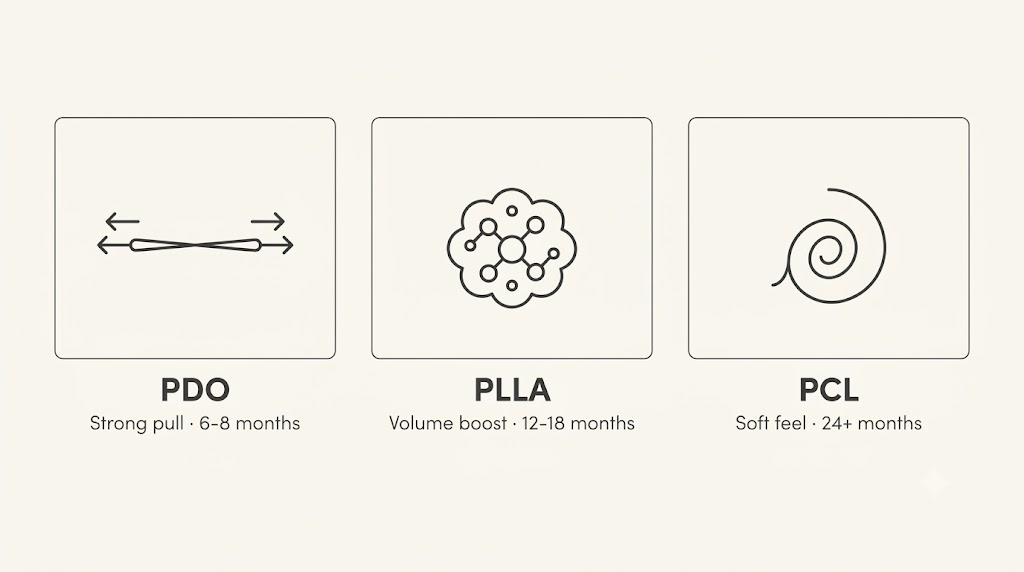
A thread lift uses absorbable threads (medical sutures that break down naturally in the body) placed under the skin to lift sagging tissue or stimulate collagen production. The threads come in three main materials — PDO, PLLA, and PCL — and each differs in lifting strength, how fast it breaks down, and how long results last.
PDO has the shortest duration at roughly 6–8 months but delivers the strongest lift. PLLA lasts around 12–18 months and adds a volume-restoring effect. PCL lasts the longest at 24 months or more (up to about three years), though its lifting strength tends to be weaker. Cost varies considerably by clinic, material, and the number of threads placed, so confirm exact pricing during your consultation.
All three are absorbable — but they break down differently
Every thread used in a thread lift is made from absorbable material that the body eventually breaks down. What differs is how and how fast. PDO (polydioxanone) is firm and tough, which gives it strong immediate traction and a quick, visible jawline-defining effect — but it fully breaks down within about 6–8 months, so results fade comparatively fast. PLLA (poly-L-lactic acid) belongs to the filler family of collagen-stimulating materials. Rather than simply pulling tissue, it triggers your own collagen production in the surrounding tissue, gradually filling in hollowed areas. It lasts roughly 12–18 months. PCL (polycaprolactone) is the most recently introduced of the three. It is the softest and most flexible, so patients tend to feel it less under the skin, and its slow breakdown means results can hold for 24 months or more — in some reports up to about three years. That said, all three perform differently depending on skin type and degree of sagging, so no single material is objectively "best."
Who this guide is written for
This guide is for anyone considering a thread lift for the first time who wants to weigh the materials before committing. Rather than looking for the one material that is universally superior, it helps to understand first that the right choice shifts based on how much sagging you have, how much facial fat, how sensitive you are to discomfort, and how long you want results to last.
Why Lift Strength and Longevity Differ by Material
Material stiffness determines lifting power
A thread's lifting power comes down to how firm and tough the material is. PDO is the stiffest and toughest of the three, so it pulls tissue upward most forcefully the moment it is placed. That force comes from the cogs (tiny barbs) along the thread catching physically on the facial retaining structures — the zygomatic cutaneous ligament (ZCL), the superficial layer of the deep temporal fascia (sDTF), and others that hold facial tissue in place — as well as on the superficial fat layer. PCL, by the same logic, is the softest and most flexible, so it is felt less under the skin but can lift less forcefully than PDO. PLLA sits somewhere in the middle for elasticity.
Hydrolysis rate determines how long results last
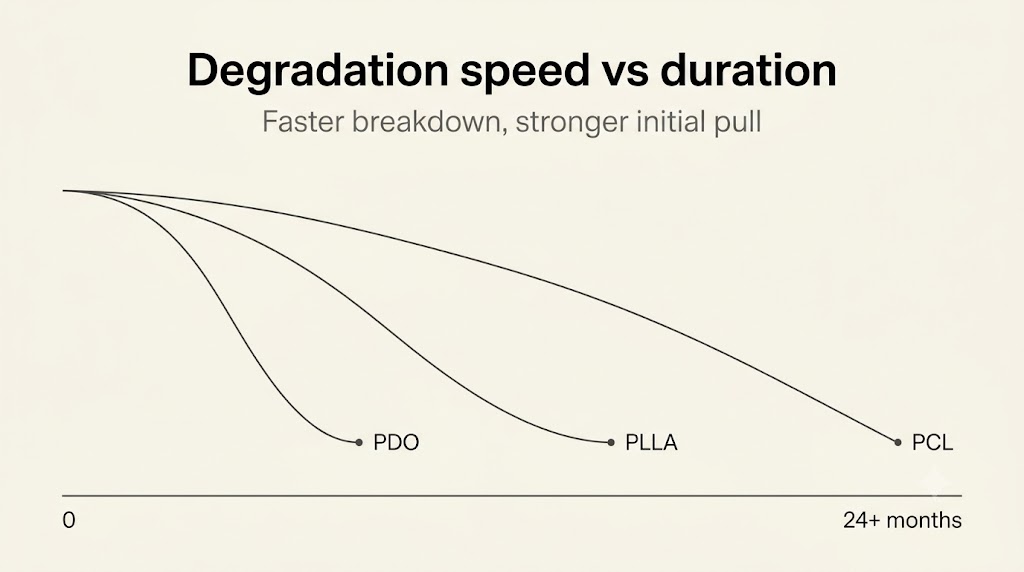
Longevity depends on how quickly the thread undergoes hydrolysis (breaking down through reaction with water in the body). PDO has a molecular structure that degrades relatively quickly, so most of it is gone within about 6–8 months. PLLA breaks down more slowly and holds for 12–18 months. PCL degrades slowest of all, remaining in the body and maintaining its effect for 24 months or more — by some reports up to about three years. In short, the faster a thread breaks down, the stronger its initial effect but the shorter its duration; the slower it breaks down, the more gradually results appear but the longer they hold — a pattern that applies across all three materials.
How they differ in stimulating collagen
All three materials have been reported in animal studies to meaningfully increase collagen (Type I and III) density in the dermis (the skin layer where collagen is concentrated), but the degree and pattern differ. PLLA is reported to be the strongest of the three at inducing the body's own collagen production, making its effect closer to "filling" than to simple lifting. PCL shows a tendency toward advantages in long-term skin regeneration. PDO also stimulates collagen, but its strength lies comparatively more in traction.
Choosing the Right Thread for Your Face
| Category | PDO | PLLA | PCL |
|---|---|---|---|
| Key characteristic | Firm and tough | Highly elastic and rigid (filler-family material) | Softest and most flexible |
| Lifting strength | Strongest | Moderate | Weaker than PDO |
| Collagen stimulation | Yes | Strongest of the three | Tends to favor long-term regeneration |
| Duration | About 6–8 months | About 12–18 months | 24 months or more (up to about 3 years) |
| Feeling of the thread / discomfort | Relatively noticeable | Moderate (technically demanding; requires an experienced injector) | Least noticeable |
| Best suited for | Heavy, thick sagging (jowls, double chin); first-time patients | Concerns about cheek hollowing; restoring volume in sunken areas | Thin, sensitive skin; wanting the longest-lasting result |
※ If you are pregnant or breastfeeding, have a skin infection, are prone to keloid scarring, or are taking anticoagulants, consult a doctor before choosing a thread type. See the "What to Consider" section below for details.
PDO: strong lift, a good starting point
If your sagging is visibly pronounced, or you need to lift heavy tissue such as jowls or a double chin, PDO's strong traction gives you a result you can see and feel quickly. The trade-off is the 6–8 month duration — maintaining the effect means planning for repeat treatment.
PLLA: lift plus volume for hollowed areas
For areas that lifting alone will not fix — hollow cheeks, sunken temples — PLLA's volume-restoring effect can help. Keep in mind that results appear gradually, so this is not the choice if you want an immediate change.
PCL: least noticeable, longest-lasting
If your skin is thin and sensitive and you are bothered by the feeling of a thread under the skin, or if you want one treatment to last as long as possible, PCL may be the better option. Its relatively weaker lift does mean there are limits to using it alone on heavily sagging areas.
Combining materials
In practice, clinicians often combine materials by area rather than using just one. A common approach places PDO along the jawline where strong traction is needed, and PCL or PLLA in areas that need elasticity or volume correction. If you are wondering whether this kind of combination can substitute for surgical lifting, or how it compares to non-surgical radiofrequency and ultrasound devices, it helps to read a guide comparing non-surgical lifting with thread lifts alongside this one [Internal link needed: Non-surgical lifting (Ultherapy, Thermage, etc.) vs. thread lift comparison]. Note that the scope of this article is limited to comparing absorbable thread materials; a direct comparison with energy-based devices requires separate review.
What to Consider: Risks, Side Effects, and Who Should Wait
🚨 When a consultation first is essential
If you are pregnant or breastfeeding, have a skin infection at the treatment site, are prone to keloid scarring (a tendency for wounds to heal into abnormally thick scars), or are taking anticoagulants (blood-thinning medication), speak with a doctor before selecting a thread material.
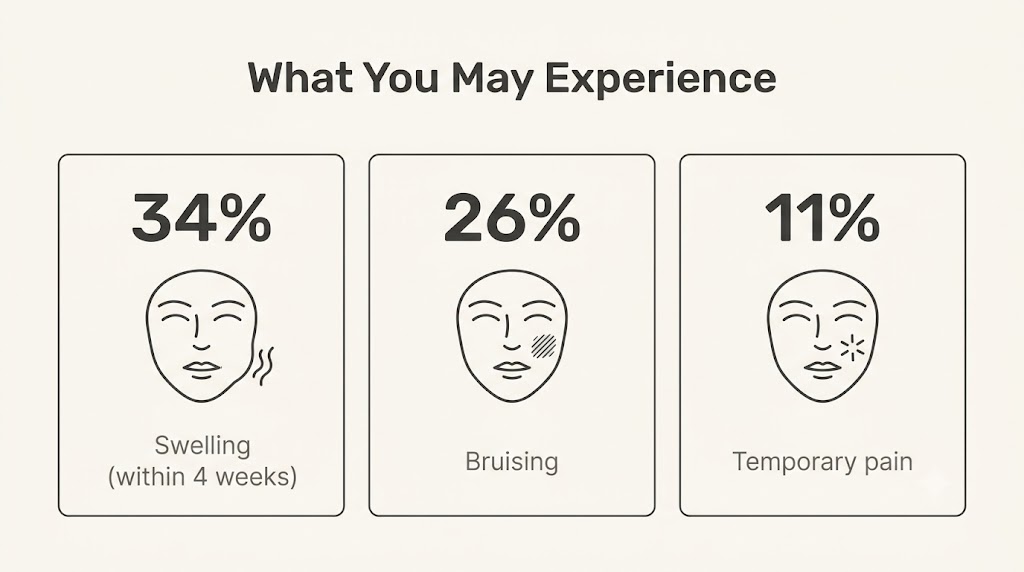
Common early reactions (swelling, bruising, pain)
A meta-analysis of 26 clinical studies covering 2,827 patients reported swelling in 34%, bruising in 26%, and temporary pain in 11% within four weeks of treatment. These are relatively common recovery responses to the irritation the skin and tissue undergo during placement, and they are generally understood to settle naturally over time. That said, severity and duration vary with your skin thickness, pain sensitivity, and the number and length of threads placed. It helps to share your routine with your doctor beforehand — when you need to return to work, when you want to resume exercise — so the guidance you get fits your situation. Source: PMC 2024 meta-analysis, "A meta-analysis of complications of thread lifting."
Rarer later complications (dimpling, visible threads)
The same meta-analysis reported complications appearing after four weeks: dimpling (skin puckering) in 7% and visible threads (threads showing through the skin) in 10%. The risk of these reactions is understood to rise particularly when PDO is used alone in areas where the skin is very thin or there is almost no subcutaneous fat. Conversely, using PCL alone on heavily sagging areas may not produce the degree of lift you were expecting. If a side effect does occur, ask your doctor when and on what grounds you should come back for a follow-up.
Next Steps: Getting a Personalized Recommendation
Pre-consultation checklist
Sorting out the following before you choose a material makes the consultation go much more smoothly.
- Where you notice sagging, and how much (jawline, cheeks, around the mouth, etc.)
- How long you want results to last (a short, immediate effect vs. a longer, gradual one)
- How sensitive you are to pain and to the feeling of a thread under the skin
- Pregnancy or breastfeeding status, current medications, and past procedure history
- If traveling from abroad, how many days you can stay
Now that you have compared the materials, the next step is having your own skin assessed in person. You can book a consultation with a specialist through the channel below.
❓ Frequently Asked Questions (FAQ)
Q1: Which thread material causes the least pain?
Of the three, PCL is the softest and most flexible, and is reported to cause comparatively less discomfort and less awareness of the thread after treatment. How much you actually feel still varies with your skin thickness and pain sensitivity.
- Why: the more flexible the thread, the less irritation when it is placed in tissue
- Best suited for: those sensitive to pain or with thin skin
Q2: Can different thread materials be combined in one treatment?
Yes — combining materials by area is a common approach in clinical practice. For example, PDO for the jawline where strong traction is needed, with softer PCL or PLLA to address elasticity in the cheeks.
- Why: different areas call for different amounts of lift and volume, so materials are distributed accordingly
- Best suited for: those whose degree of sagging varies from area to area
Q3: What side effects can occur after a thread lift?
Within the first four weeks, recovery responses such as swelling (34%), bruising (26%), and temporary pain (11%) are common. After four weeks, less frequent reactions such as dimpling (7%) and visible threads (10%) have been reported.
- Evidence: PMC 2024 meta-analysis, "A meta-analysis of complications of thread lifting," 2,827 patients across 26 studies
Q4: Do PLLA threads (a filler-family material) add volume the way filler does?
PLLA is the strongest of the three at inducing your own collagen production in surrounding tissue, so beyond simply lifting, you can expect hollowed areas to gradually fill in. The effect takes time to appear and varies between individuals.
- Why: volume restoration through stimulation of Type I and III collagen production
- Best suited for: correcting hollow cheeks, sunken temples, and similar areas
Q5: Do I need another treatment once the duration ends?
The thread itself breaks down in the body, but the collagen regeneration it stimulated along the way can persist for a period — so whether to repeat treatment depends on your skin condition and how much sagging has returned.
- Best suited for: those who notice sagging returning after the effect has worn off