The Complete Guide to 'Zeronate,' a 0.01mm Natural-Tooth-Preserving Technique (2026)
Published: 2026-10-15
💡 Key Takeaways at a Glance
- Key feature: A veneer procedure ranging from completely no-prep to minimal selective tooth reshaping within the enamel, depending on the condition of your teeth.
- Tiers and cost: Four tiers — ZERO, ONE, ATE, and MARTH — priced from ₩977,900 to ₩2,205,000 per tooth, with warranties of 2 to 13 years.
- Timeline: An average of around 2 weeks (a 1-day course is possible), though misalignment requiring surgical correction, deep cavities, severe gum inflammation, or severe teeth grinding need to be diagnosed and addressed first.
🎯 Who this guide is for: Anyone who wants to improve the shape, alignment, or discoloration of their teeth while minimizing tooth reduction, and anyone researching dental procedures in Korea from abroad.
1. Is Zeronate the Right No-Prep Veneer for You? The Essentials First
Direct Answer: Zeronate at a Glance
Zeronate is a veneer procedure that improves the shape, color, and alignment of your teeth with little to no tooth reduction, by designing veneers as thin as roughly 0.01mm to preserve as much of your natural tooth structure as possible. These ultra-thin ceramic shells are bonded seamlessly to the enamel (the tooth's outer surface) with a strong adhesive, essentially becoming one piece with the tooth and strong enough to withstand everyday chewing forces.
Depending on the condition of your teeth, treatment can sometimes be done with no reduction at all, but if there's significant unevenness in alignment or size, only minimal selective tooth reshaping within the enamel (the hard outer layer covering the tooth's surface) is applied. Treatment is divided into four tiers — ZERO, ONE, ATE, and MARTH — priced from ₩977,900 to ₩2,205,000 per tooth, with warranty periods ranging from 2 to 13 years depending on the tier. The average treatment period, from examination to placement, is around 2 weeks, though some courses can be completed in as little as 1 day depending on the plan.
That said, if you have misalignment or bite issues that require surgical correction, deep cavities, severe gum inflammation, or severe teeth grinding or clenching, you'll need to treat those conditions first or be evaluated to confirm whether you're a suitable candidate.
Who Zeronate Is a Good Fit For vs. Who Should Consider Other Treatment First
| May Be a Good Candidate | Should Consider Other Treatment First |
|---|---|
| Teeth with uneven shape or size | Alignment or bite issues that require surgical correction |
| Gaps between teeth or uneven alignment | Deep cavities or severe gum inflammation |
| Wanting to naturally brighten stained or discolored teeth | Severe teeth grinding or clenching (decided after diagnosis, together with a protective device) |
| Wanting to redo existing veneers or dental prosthetics | Cases where the exam determines the procedure isn't suitable |
| Wanting to improve the gum line as well |
2. Why Is No-Prep Possible? The Principle Behind No-Prep Veneers and How Dentists Decide
When No Reduction Is Possible vs. When Selective Reshaping Is Needed
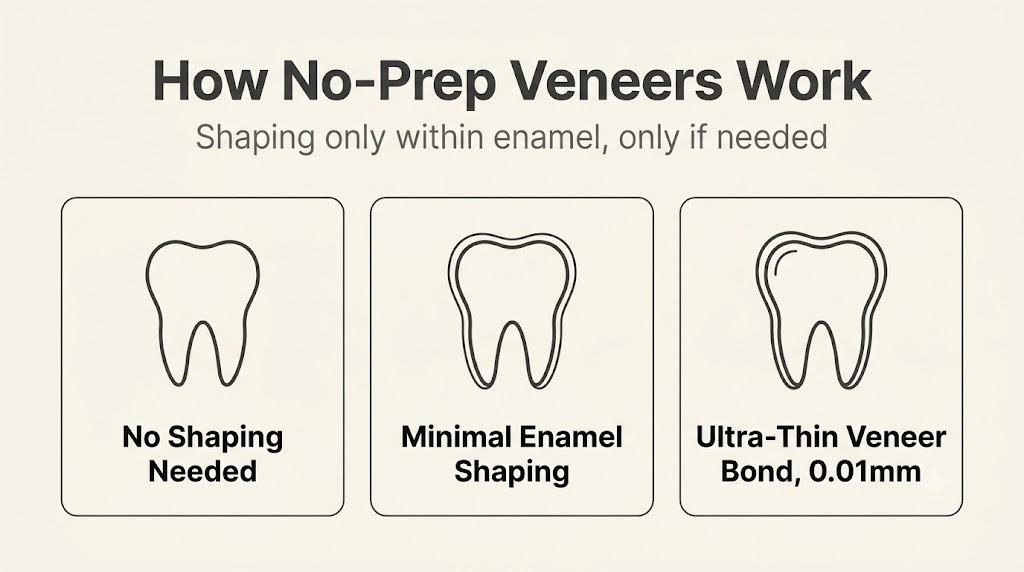
Whether veneers can be attached without reducing the tooth depends on the alignment, shape, and size of your teeth. If your teeth are relatively well-aligned and not significantly protruding, veneers can be attached as-is with no preparation (no-prep). But if there are large gaps between teeth or one tooth protrudes noticeably more than the others, selective tooth reshaping is applied — limited to a minimal amount within the enamel. This approach keeps the reduction limited so that it does not reach the dentin (the layer beneath the enamel that is closer to the nerve).
This decision is made by the dentist after a detailed oral exam and, if necessary, 3D-CT imaging to check the tooth structure and nerve position. In other words, "no-prep" isn't a fixed outcome that applies identically to every patient — it's more accurate to understand it as a range, where the amount of reduction can be close to zero or a small amount within the enamel, depending on each patient's individual tooth condition.
💡 Keep in Mind
"No-prep" isn't a marketing phrase — it's a range that depends on your tooth condition. Whether your teeth need no reduction at all, or a small amount of reshaping within the enamel, can only be confirmed after a consultation and exam.
Differences in Design and Fabrication by Tier
All four tiers — ZERO, ONE, ATE, and MARTH — use the clinic's in-house design system and go through a customized design process that factors in facial proportions, smile line, speech, and chewing function. The staff team assigned differs by tier: ZERO is handled by the clinic director and a ceramist (a technician who hand-carves and shades the ceramic veneers to match the tooth); ONE by a senior ceramist; ATE by a senior director and lead ceramist; and MARTH by a dedicated dentist and lead ceramist.
However, there's no publicly available data that objectively demonstrates the actual skill difference between a "ceramist," "senior ceramist," and "lead ceramist," so if you're curious about how results might differ between tiers, it's worth asking to see portfolios or case examples directly during your consultation.
3. Your Options: The 4 Zeronate Tiers and Other Alternatives
What's Included in Each Tier — ZERO, ONE, ATE, MARTH
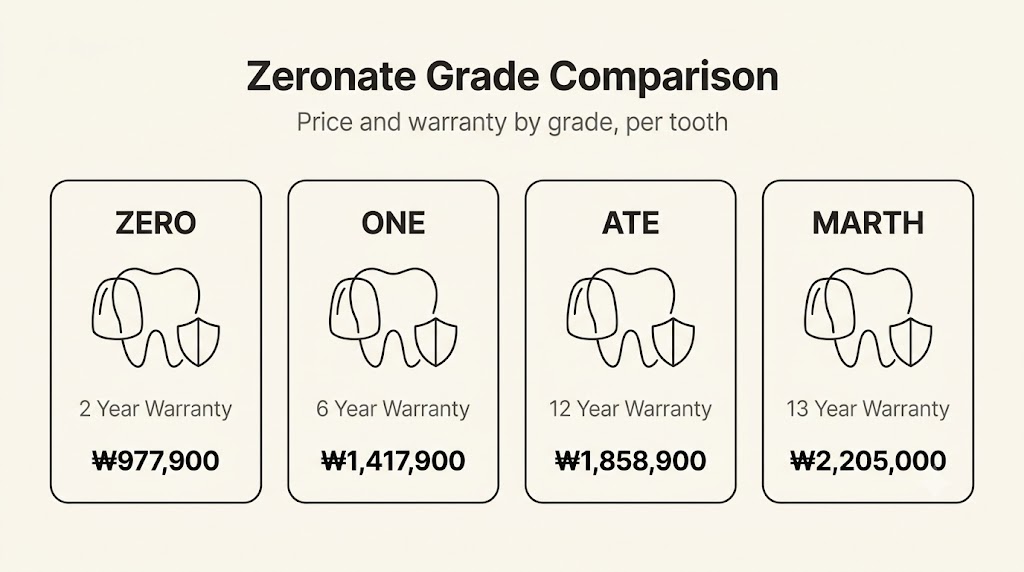
| Category | ZERO | ONE | ATE | MARTH |
|---|---|---|---|---|
| Price (per tooth) | ₩977,900 | ₩1,417,900 | ₩1,858,900 | ₩2,205,000 |
| TU CARE+ warranty period | 2 years | 6 years | 12 years | 13 years |
| Staff team | Director + ceramist | Director + senior ceramist | Senior director + lead ceramist | Dedicated dentist + lead ceramist |
| Average treatment period | ~2 weeks (1-day minimum) | ~2 weeks (1-day minimum) | ~2 weeks (1-day minimum) | Confirmed individually at booking |
Pricing and treatment process for Zeronate ZERO covers the assigned staff and warranty scope in detail. One tier up, details on Zeronate ONE show that fabrication is handled by a senior ceramist, with the warranty extending to 6 years. The ATE tier limits the number of patients seen per day, and you can check the assigned staff and additional services on the Zeronate ATE treatment page. The highest tier, MARTH, is handled by a dedicated dentist in a separate, private space — see the Zeronate MARTH treatment page for booking details and stay planning.
Tier names, private treatment spaces, and concierge services reflect the clinic's own service structure, and a higher tier does not guarantee a better clinical outcome.
Comparing Alternatives: Traditional (Prep) Veneers, Teeth Whitening, and More
Zeronate isn't the only way to improve your teeth. Traditional prep veneers involve reducing part of the enamel before attaching the veneer, and the more enamel that's removed, the harder it can be to return the tooth to its original structure. Teeth whitening changes only the color with no reduction, so it doesn't address shape or alignment issues, while clear aligners can correct alignment but take longer. We'll cover the side effects and maintenance of traditional prep veneers, along with a comparison of teeth whitening and clear aligners, in separate articles.
| Category | Zeronate (no-prep style) | Traditional prep veneers |
|---|---|---|
| Tooth reduction | None to minimal, within the enamel, depending on condition | Generally some enamel removal before attachment |
| Design thickness | About 0.01mm (an ultra-precise custom fit, as thin as a contact lens) | About 0.3mm–0.7mm (the front of the tooth must be reduced by roughly this much) |
| Reversibility | Relatively reversible when no reduction is involved | Can be irreversible, depending on how much was removed |
| Warranty/maintenance | TU CARE+, 2–13 years depending on tier | Varies by clinic (typically around 1–3 years) |
4. Things to Consider: Risks, Side Effects, and Who Should Consider Other Treatment First

If you have misalignment or bite issues that require surgical correction, deep cavities, severe gum inflammation, or severe teeth grinding or clenching, you should treat those conditions first, or be evaluated to confirm whether you're a suitable candidate, rather than proceeding with Zeronate right away. Even though very little (or no) tooth is removed, outcomes can still vary depending on bonding conditions and bite habits, so this cannot be described as a procedure with no risk of side effects whatsoever. For specific clinical data on long-term dental health effects and complication rates of no-prep or enamel-only selective reshaping, it's best to ask your dentist directly during your consultation.
🚨 Contact Your Clinic Immediately If You Notice These Symptoms
If you experience ongoing sensitivity or discomfort after placement, or if a veneer feels loose, falls off, or chips, don't wait it out — contact your clinic right away.
Possible Issues After Placement
- You may feel sensitivity or discomfort right after placement.
- Veneers may loosen, fall off, or chip when biting hard or sticky foods.
- Habitually biting down on hard objects with your front teeth can increase the risk of damage.
Who Should Not Proceed With Treatment (Exclusion Criteria)
- Misalignment or bite issues requiring surgical correction — this needs to be treated first.
- Deep cavities or severe gum inflammation — treat these first, then reassess eligibility.
- Cases where an exam determines Zeronate isn't suitable — you'll be offered alternative treatment options.
Precautions for Patients Who Grind or Clench Their Teeth
If you grind your teeth or clench your jaw severely, you need to disclose this during your consultation so that, after diagnosis, you can be given appropriate countermeasures such as a protective device. If treatment proceeds without protective measures, repeated stress on the veneers can increase the risk of chipping or detachment. Unconscious grinding or clenching puts significant force on the front teeth, and without a protective device, the ceramic is more likely to chip or come loose sooner. Specific long-term retention-rate data for patients with teeth grinding who received Zeronate is not yet publicly available, so if your symptoms are severe, be sure to get a detailed diagnosis before treatment and ask about using a nightguard (grinding-protection device) while you sleep.
5. Getting Treatment in Korea: Cost, Length of Stay, Number of Visits, and Recovery
The cost of Zeronate depends on the tier and the number of teeth being treated, ranging from ₩977,900 (ZERO) to ₩2,205,000 (MARTH) per tooth. The average treatment period — from examination and consultation through design, fabrication, and placement — is around 2 weeks, though a 1-day course is possible if your schedule allows.
Pricing by Tier (KRW/USD)
| Tier | Price (per tooth, KRW) | USD equivalent | TU CARE+ warranty period |
|---|---|---|---|
| ZERO | ₩977,900 | approx. US$675 (subject to exchange-rate fluctuation) | 2 years |
| ONE | ₩1,417,900 | approx. US$675 (subject to exchange-rate fluctuation) | 6 years |
| ATE | ₩1,858,900 | approx. US$675 (subject to exchange-rate fluctuation) | 12 years |
| MARTH | ₩2,205,000 | approx. US$675 (subject to exchange-rate fluctuation) | 13 years |
Treatment Timeline and Number of Visits
Treatment generally follows 7 steps: ① Exam and consultation (3D-CT if needed) → ② Design → ③ Removal of any existing dental work (laser if needed) → ④ Selective tooth reshaping (if needed) → ⑤ Fabrication → ⑥ Try-in and placement → ⑦ Aftercare instructions. Typically, this means 2 clinic visits in total — one for the exam/design and one for try-in/placement — and if your time in Korea is limited, you can arrange with the clinic in advance to complete everything in a single "one-day course." For the highest tier, MARTH, a dedicated staff member coordinates the schedule around your personal itinerary. The exact number of visits required for each tier will be confirmed individually when you book.
Before You Leave Home
- Disclose any medications you're taking, allergies, and underlying conditions in advance
- Bring recent dental panoramic or CT images
- Share your history of any previous veneers or prosthetic work (timing and clinic)
- Prepare reference photos of the tooth shape and color you want
- Let the clinic know your available length of stay when booking
Dedicated interpreters (for English and other languages) are available to explain your treatment one-on-one for international patients, and support is available for communication if issues arise after you return home. It's a good idea to request interpretation in advance when booking.
Managing Your Recovery After Placement
Right after placement, avoid hard or sticky foods and avoid biting down on hard objects with your front teeth. Since this isn't a surgical procedure involving bleeding or anesthetic injections, you're generally told you can return to daily life and light meals right after placement, and most people feel fully comfortable after a day or two of adjustment. After that, keep up consistent oral hygiene — including brushing and flossing — and attend regular dental checkups. If you notice sensitivity, discomfort, or a veneer that feels loose, falls off, or chips, contact the clinic right away; if a problem comes up after you've returned home, it's recommended to contact the treating clinic's patient support team first. Recovery timelines can vary by individual, so check with your dentist for specifics during your consultation.

❓ FAQ: Frequently Asked Questions About Zeronate
Q1: Does Zeronate really involve zero tooth reduction?
Depending on the condition of your teeth, treatment is often done with no tooth reduction at all, but in some cases involving uneven alignment, shape, or size, minimal selective tooth reshaping within the enamel may be required. Whether reduction is needed is determined after a detailed oral exam and, if necessary, 3D-CT imaging, and even when some reduction is done, it stays limited to a minimal amount of enamel without touching the deeper layer near the nerve (dentin).
Q2: What's the difference between the Zeronate tiers (ZERO, ONE, ATE, MARTH) besides price?
The tiers differ in the assigned staff team and the length of the TU CARE+ warranty, and pricing ranges from ₩977,900 to ₩2,205,000 per tooth.
- ZERO: 2-year warranty, ₩977,900
- ONE: 6-year warranty, ₩1,417,900
- ATE: 12-year warranty, ₩1,858,900
- MARTH: 13-year warranty, ₩2,205,000
Higher tiers involve a senior or lead ceramist — rather than a regular ceramist — directly participating in design and fabrication.
Q3: I grind my teeth badly — can I still get Zeronate?
If you have severe teeth grinding or clenching, you'll be given protective measures to follow after diagnosis, and treatment may be limited depending on your condition. You must disclose any grinding or clenching habits during your pre-treatment consultation, and without a protective device (nightguard), veneers may chip or fail sooner.
Q4: I'd need to travel to Korea — how long do I need to stay?
The average treatment period, from examination to placement, is around 2 weeks, though some courses can be completed in as little as 1 day depending on the plan. If your stay is short, you can arrange a "1-day course" in advance with the clinic, and the exact length of stay you'll need will be confirmed individually when you book.
Q5: What should I prepare before leaving for Korea?
Disclose any medications you're taking, allergies, and underlying conditions in advance, and prepare recent dental panoramic or CT images, your history of previous veneers, and reference photos of the design you want. Letting the clinic know your available length of stay when booking also helps with scheduling.
7. Next Steps: What to Prepare Before Your Consultation
Checklist Before You Request a Consultation
- Make a list of medications you're taking, allergies, and underlying conditions
- Get hold of recent panoramic/CT images
- Note your history of previous veneers or prosthetic work (timing and clinic)
- Gather reference photos of the tooth shape and color you want
- Decide on your available length of stay in advance
Connect With a Partner Clinic for a Consultation
📍 Request a Consultation
Zeronate is performed at TU Dental Clinic. You can view an overview of the clinic at TU Dental Clinic's provider page, and for specific tier selection or scheduling, you can request a consultation here.