Thread Lift in Korea: Effects, Cost, Recovery, Side Effects, and More (2026)
Originally published: 2026-10-14
💡 Quick Summary: At a Glance
- Cost: About ₩3,000,000 at Glovi Plastic Surgery, procedure takes 30 minutes to 1 hour, same-day discharge.
- Recovery: Official recovery period is 7 days; a follow-up visit 3–4 weeks after the procedure is required to check for dimpling.
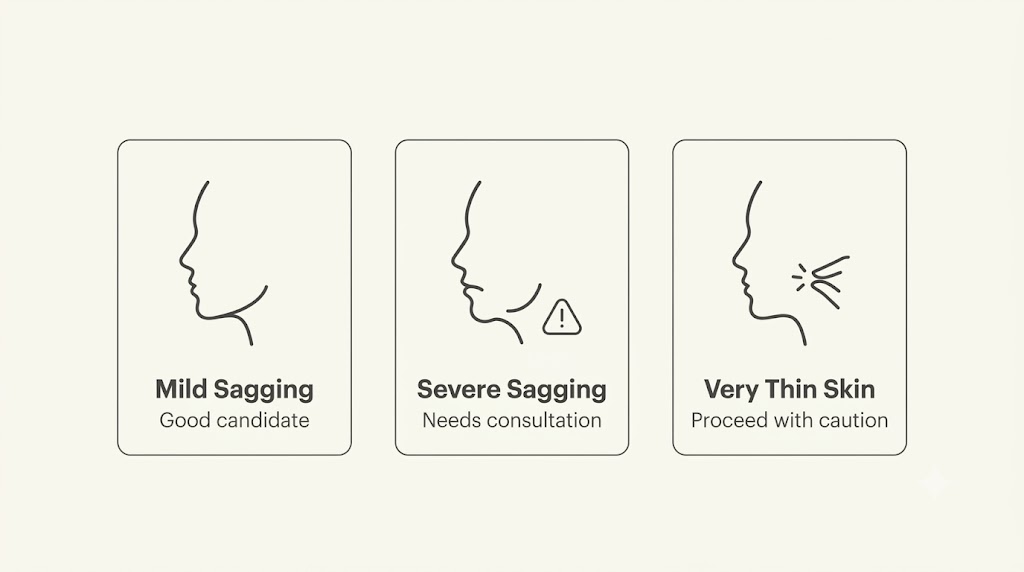
- Who it suits: Works well for mild-to-moderate sagging in patients in their 20s–40s; may not be suitable for patients 50 and older with severe sagging or very thin skin, due to concerns about insufficient anchoring or visible barb ridges.
🎯 Who This Guide Is For: International patients considering a non-incisional V-line lift who want to check cost, recovery, and candidacy in advance.
A thread lift involves inserting dissolvable threads (PDO, medical threads that gradually break down inside the skin) beneath the skin to lift sagging cheeks and jawline without incisions. In Korea, it's commonly known as a V-line lift, and while costs vary by clinic and treatment area, pricing at Glovi Plastic Surgery starts at around ₩3,000,000.
The procedure itself takes 30 minutes to 1 hour with same-day discharge, and the official recovery period is 7 days. However, for patients 50 and older, or those with significant sagging or very thin skin, the procedure may not be suitable due to insufficient anchoring or visible thread barbs, so a consultation with a specialist is essential beforehand. A follow-up visit 3–4 weeks after the procedure is also required to check for dimpling.
What Is a Thread Lift? Who It Suits in Korea
Defining a Thread Lift (V-Line Lift)
A thread lift physically lifts sagging tissue by inserting dissolvable, barbed threads into a specific layer beneath the skin. Because the threads are inserted through a thin needle (cannula) rather than an incision, it's classified as a non-incisional lift. Patients can choose between sedation or local anesthesia, the procedure takes 30 minutes to 1 hour, same-day discharge is possible, and there is no suture-removal process.
The threads used are made of PDO (polydioxanone) and have 6–8 barbs per 1 cm that grip the tissue, and they are absorbed by the body over roughly six months. Even after absorption, collagen (the fibrous protein that supports skin elasticity) continues to regenerate at the sites the threads stimulated, which can help maintain some improvement in firmness — though how long this lasts varies significantly between individuals. In general, the threads themselves are gradually absorbed over about six months, during which the physical lifting effect from the threads gradually diminishes, but the added collagen regeneration effect means overall firmness improvement generally lasts around six months to under a year. That said, the duration varies considerably depending on the patient's age and the initial degree of sagging.
How the Non-Incisional Procedure Works
The effect comes from two combined mechanisms: the anchoring force created as the barbs grip the tissue beneath the skin, and the collagen regeneration response triggered as the threads break down. If either mechanism fails to work adequately due to the condition of the tissue, the lifting results may fall short of expectations.
Who This Procedure Suits
Patients in their 20s–40s with mild-to-moderate sagging and some remaining skin elasticity tend to respond relatively well. In patients in their 20s, sagging is often minimal, so even a small number of threads can produce a noticeable change. On the other hand, those with excess skin laxity or very thin tissue may fall into the exclusion criteria covered in the "Things to Consider" section below.
Why Skin Sags and How a Thread Lift Works
The Background Behind Skin Sagging
As we age, collagen and elastic fibers in the skin decrease, and the supportive structure beneath the skin — the SMAS layer and related fascial tissue, a thin fibromuscular layer (SMAS, superficial musculoaponeurotic system) located deeper than the dermis that connects the facial muscles to the skin and holds it taut — loosens, causing the cheeks and jawline to sag downward. Gravity and repeated use of facial expression muscles also accelerate this process.
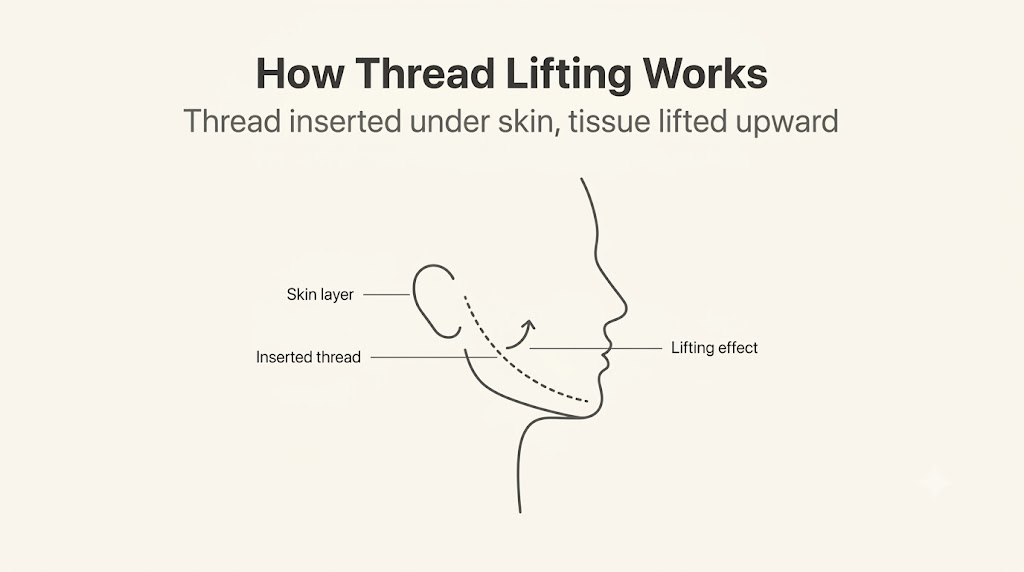
PDO threads are made of a biodegradable material also used in surgical sutures. Immediately after insertion, the barbs physically lift the tissue, and as the threads break down over time, they create microscopic stimulation in the surrounding tissue that triggers collagen production. In other words, the effect happens in two stages: an immediate lifting effect at first, followed by improved firmness through tissue regeneration.
Barb Structure and Anchoring Strength
The higher the barb density (6–8 per 1 cm), the stronger the anchoring force — but in very thin skin, this also increases the risk that the barb shape becomes visible or creates an uneven surface. For this reason, the number, thickness, and insertion angle of the threads must be individually adjusted based on skin thickness.
Alternatives Worth Considering Besides a Thread Lift
There are various lifting methods beyond a thread lift. Depending on the degree of sagging and skin condition, non-surgical RF (radiofrequency) lifting or a surgical facelift may be more suitable. The table below compares all three approaches using the same criteria.
How Dissolvable (PDO) Threads and Collagen Production Work
| Category | Thread Lift (V-Line Lift) | Facelift (Surgical) | Non-Surgical RF Lifting |
|---|---|---|---|
| Best For | Mild-to-moderate sagging, mainly patients in their 20s–40s | Severe sagging and excess skin, typically patients 50 and older | Mild loss of elasticity; for those who want to avoid incisions or thread insertion |
| Anesthesia | Sedation or local anesthesia | General anesthesia or deep sedation | Sedation or local anesthesia |
| Recovery Period | About 7 days | About 1–2 weeks (until stitch removal and major swelling subsides) | About 7 days (same-day discharge possible) |
| Scarring | Tiny insertion points only, non-incisional | Surgical scars (permanent incision scars along the hairline or around the ears) | None |
| Duration of Effect | Some lifting remains from collagen regeneration even after the threads absorb (6 months); varies by individual | About 6 months to under a year | About 6 months to under a year |
Thread Types: PDO vs. PLLA vs. PCL
The threads used in thread lifts also differ in how quickly they break down and how much tissue stimulation they create, depending on material. Knowing the differences between the three types of dissolvable threads used in thread lifts ahead of time can help you choose the right option during your consultation.
👉 Wondering how the thread material affects results and stimulation intensity? See the comparison of 3 types of dissolvable threads used in thread lifts
Non-Surgical RF Lifting Alternatives (Onda, Oligio)
If you'd rather avoid thread insertion altogether, non-surgical options that use radiofrequency or ultrasound energy to stimulate collagen beneath the skin are also worth considering. Comparing how Onda and Oligio lifting work can help you gauge which device better suits your level of sagging.
👉 Curious about boosting firmness with radiofrequency, without inserting any threads? Compare how Onda vs. Oligio lifting work
How It Differs from Ulthera, Thermage, and InMode
Even among non-surgical lifting options, Ulthera, Thermage, and InMode differ in how they deliver energy and which tissue depth they target. Reviewing how Ulthera, Thermage, and InMode work can make it easier to understand how their results compare to a thread lift.
👉 How do Ulthera, Thermage, and InMode differ from a thread lift? Read the Ulthera vs. Thermage vs. InMode comparison guide
Comparing with a Surgical Facelift
When sagging is severe or there's enough excess skin that anchoring with threads alone isn't enough, a surgical facelift — which directly incises and lifts the skin and tissue — may offer a more fundamental solution. However, because it involves incisions, it comes with a greater burden in terms of scarring and recovery time compared to a thread lift.

Things to Consider: Risks, Side Effects, Limitations, and Exclusions
🚨 This Procedure May Not Be Suitable If
A thread lift may not be suitable for patients 50 and older with significant skin sagging or laxity, or those with very thin skin. If either applies to you, be sure to get a consultation before proceeding.
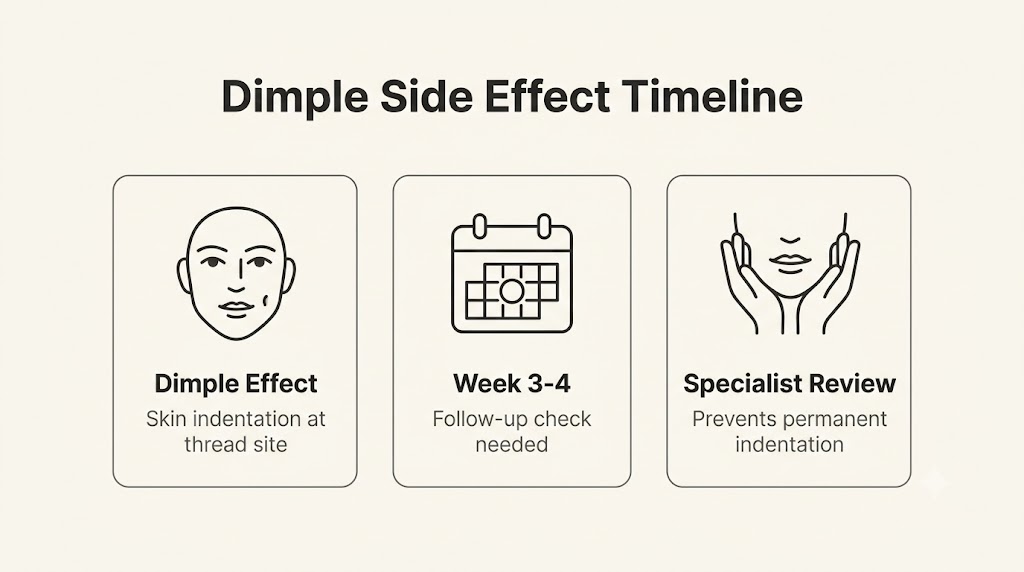
The side effect requiring the most caution with a thread lift is dimpling (a sunken, dimple-like indentation). This occurs when the skin at the thread insertion site caves in like a dimple, which can happen if the thread's barbs pull the tissue too aggressively or the insertion angle was off. Most cases resolve to normal when a specialist releases the area directly during the 3–4 week follow-up visit, but if this window is missed and the issue is left untreated, there is a risk it could become permanent.
The exclusion criteria are also clear. Patients 50 and older with significant sagging or skin laxity may not see sufficient improvement from thread anchoring alone and may be better suited to a facelift, and patients with very thin skin are at risk of the thread barbs or their shape becoming visible or creating an uneven surface — so a pre-procedure consultation is essential.
Other Complications
- Infection or inflammatory reaction at the insertion site
- In thin skin, the threads becoming visible beneath the surface, or the ends protruding through the skin
- Temporary facial asymmetry caused by differences in tension across the inserted threads
Absolute Contraindications
- Pregnant or breastfeeding patients
- Those prone to keloid scarring
- Patients with blood clotting disorders that prevent normal clotting
- Patients with an allergy to biodegradable suture material (PDO)
Be sure to confirm during your consultation whether any of the above apply to you.
Getting a Thread Lift in Korea: Cost, Duration, Visits, and Recovery
Cost Range (KRW/USD)
| Item | KRW | USD |
|---|---|---|
| V-Line Lift (Glovi Plastic Surgery) | ₩3,000,000 | approximately $2,000–$2,300 |
Cost can vary depending on the number of threads inserted and the treatment area. Based on ₩3,000,000, the final cost may increase if the degree of sagging and the injection area call for a different number of threads or directional design.
👉 Want to know exactly what's included in the procedure cost? Check Glovi Plastic Surgery's V-Lift procedure information page
Recommended Length of Stay
There's no suture-removal step, but the 3–4 week follow-up check is essential. The procedure itself allows same-day discharge, but because any dimpling that develops afterward needs to be checked and directly released by medical staff, staying in Korea until roughly 3–4 weeks after the procedure is the most strongly recommended plan. If an extended stay isn't possible, you should arrange in advance whether an in-person follow-up check can be done before you leave.
Number of Visits (Including Follow-Up)
At minimum, 2 visits are needed (1 for the procedure + 1 for the follow-up check). The procedure itself allows same-day discharge, but because any dimpling that develops afterward needs to be checked and directly released by medical staff, staying in Korea until roughly 3–4 weeks after the procedure is recommended. If an extended stay isn't possible, arrange in advance whether an in-person follow-up check can be done before you leave.
Swelling and Recovery Timeline
Recovery progresses through distinct stages by day.
- Days 0–2: Swelling and tightness are at their peak; you may feel a pulling sensation and heaviness.
- Days 3–5: Swelling noticeably decreases.
- Around 1 week: Most of the swelling has subsided and the contour stabilizes; the official 7-day recovery period ends.
- Weeks 3–4: A separate final follow-up check (to assess for dimpling) takes place.
During recovery, avoid excessive massage, strong facial expressions, drinking, smoking, and saunas, and use cold compresses to manage swelling if needed. Getting adequate rest on the day of the procedure and the following day is recommended.
💡 Pre-Departure Checklist
Medications to Pause: It's advisable to discuss with your physician about temporarily stopping anticoagulants (such as aspirin) that can cause bleeding or bruising, and to avoid heavy drinking the day before the procedure.
Support in English: A dedicated international care coordinator can provide one-on-one English consultations and multilingual aftercare guides.
Partner Hospital: You can check hospital details on the Glovi Plastic Surgery page, where thread lift consultations are available.
❓ Frequently Asked Questions (FAQ)
Q: How much does a thread lift cost in Korea?
Around ₩3,000,000 for a V-lift at Glovi Plastic Surgery, though it can vary by clinic, treatment area, and number of threads used.
- Cost: ₩3,000,000 (V-lift, Glovi Plastic Surgery)
- USD equivalent: approximately $2,000–$2,300 (may vary with thread count)
- Range of variation: the final cost may increase if the degree of sagging and injection area call for a different number of threads or directional design.
Q: How long do thread lift results last?
The threads are absorbed by the body after about six months, but some improvement in firmness can remain afterward thanks to collagen regeneration.
- Thread absorption point: about six months
- Effect after absorption: the physical lifting effect from the threads gradually diminishes after six months, but combined with collagen regeneration, results generally last around six months to under a year.
- Retreatment cycle: patients can discuss retreatment with a specialist around the one-year mark, once sagging becomes noticeable again.
Q: What is dimpling, a possible side effect after a thread lift?
It's when the skin at the thread insertion site caves in like a dimple; most cases return to normal once a specialist releases the area during the 3–4 week follow-up check.
- Where it occurs: skin at the thread insertion points
- When it's checked: a follow-up visit 3–4 weeks after the procedure is required
- Risk if left untreated: it can become permanent, so a specialist consultation is necessary
Q: How many days until I can return to normal activities after a thread lift?
Days 0–2 bring the most swelling and tightness; it eases from days 3–5, and most of it has stabilized by around 1 week.
- Days 0–2: swelling and tightness peak
- Days 3–5: noticeable reduction in swelling
- Around 1 week: official recovery period ends, mostly stabilized
- Recovery guidelines: avoid drinking, smoking, saunas, and excessive massage
Q: Can I get a thread lift if I'm older?
In patients in their 20s, where sagging is minimal, even a small number of threads can be effective — but for patients 50 and older with significant sagging or laxity, anchoring strength may be insufficient, and a facelift may be more suitable.
- How it works: the thread's anchoring strength depends on remaining skin elasticity
- Who it suits: patients with mild-to-moderate sagging
- What to check: very thin skin may risk visible barbs — a pre-procedure consultation is essential
Next Steps: Making the Right Choice for You
Pre-Consultation Checklist
It helps to first assess your own age range, degree of sagging, and skin thickness before going into a consultation. If you're in your 20s–40s with mild-to-moderate sagging, a thread lift may be an option to consider; but if you're 50 or older with severe sagging, or have very thin skin, you should first compare it against a facelift or non-surgical lifting options. Confirm cost, recovery time, and the follow-up check schedule together before making a decision.
Learn More About Related Procedures
Once you've narrowed down the option that suits you, the next step is to get your skin condition diagnosed through a direct consultation with a specialist. You can request a consultation to ask about thread lifts and lifting procedures in general.