
Presbyopia and Cataracts Surgery in Korea: Multifocal Intraocular Lens (IOL) Implantation (2026)
Published: 2026-09-18 · Last updated: 2026-09-18
💡 Quick Summary: At a Glance
- Goal: The aim is to remove the natural lens clouded by cataracts while implanting an artificial lens that provides multiple focal points, so that cataracts and presbyopia can be improved together in a single surgery.
- Cost range: Monofocal lenses cost around ₩720,000–2,000,000 per eye, while premium multifocal lenses cost around ₩6,000,000–14,000,000 for both eyes.
- Possible side effects: Multifocal lenses can cause nighttime glare (glare and halos) and reduced contrast sensitivity, so thorough pre-operative examination is essential.
- Schedule for international patients: Considering sequential surgery on both eyes and recovery management, a stay of around 2–3 weeks in Korea is recommended.
🎯 Who This Guide Is For: This guide is for people experiencing presbyopia and cataracts together who want to reduce their dependence on reading glasses after surgery, as well as for overseas Koreans and international patients considering this procedure in Korea.
1. What Is Multifocal IOL Implantation? For Those Experiencing Presbyopia and Cataracts Together
Multifocal intraocular lens (IOL) implantation is a procedure that removes the natural lens (the tissue inside the eye that functions like a camera lens) once it has become clouded by cataracts, and replaces it with an artificial lens designed to provide several focal points at once—with the aim of improving both cataracts and presbyopia in the same surgery. The exact cost and number of days required vary depending on the individual's eye condition and the type of lens chosen.
Costs vary significantly depending on the surgical method and lens type used. Standard, Zepto, and laser-assisted monofocal lenses cost around ₩720,000–2,000,000 per eye (unilateral). Premium multifocal IOLs that correct cataracts and presbyopia at the same time, such as PanOptix Pro, are not covered by national health insurance and cost around ₩3,000,000–7,000,000 per eye, or around ₩6,000,000–14,000,000 for both eyes (bilateral). The surgery itself is relatively short, taking around 15–30 minutes per eye, and it is standard practice to operate on each eye with an interval of one day to one week between them, to prevent infection and allow vision to stabilize. Return to daily activities is generally possible within a few days, but it takes around 1–3 months for vision to fully settle and for the brain to adapt to the multifocal lens. Because there is a possibility of side effects such as nighttime glare, a thorough pre-operative examination and consultation are essential to determine whether this procedure is right for you.
Presbyopia and cataracts are separate, age-related changes in the eye, but they commonly appear around the same time, often from the late 40s onward. Presbyopia occurs when the lens loses elasticity and the eye's ability to focus on nearby objects weakens, while cataracts occur when the lens itself becomes clouded, causing overall blurred vision. When the two conditions overlap, you may notice that the range of distances at which you can see clearly keeps narrowing, whether near or far.
Multifocal IOL implantation aims to reduce dependence on reading glasses after surgery by inserting a lens that provides multiple focal points—rather than a standard lens providing only a single focus—while removing the clouded lens during cataract surgery. However, this goal is not achieved to the same degree for everyone, and results can vary depending on individual factors such as corneal condition, pupil size, and pre-existing eye conditions. For this reason, it is more accurate to describe the expected outcome as "improvement in near-vision decline caused by presbyopia is expected" rather than to state that presbyopia is completely resolved.
How Presbyopia and Cataracts Differ, and Why They Often Occur Together
Presbyopia is a complex decline in near-focusing ability that occurs as the ciliary muscle (the muscle that adjusts the thickness of the lens) weakens and the lens itself loses elasticity, while cataracts result from the clouding caused by changes in the lens proteins. Although the underlying mechanisms differ, both conditions tend to progress within a similar age range because they share aging as a common cause.
Who This Procedure May Be Suitable For
People who have been diagnosed with cataracts and are also experiencing reduced near vision (presbyopia), and who want to reduce their dependence on reading glasses after surgery, are the primary candidates for consideration. However, final suitability is determined based on the results of a thorough pre-operative examination.
2. Why Multifocal Lenses Are Emerging as an Alternative
Monofocal IOLs, which have traditionally been used in cataract surgery, are focused on only one distance, which often meant that reading glasses were still needed for near-vision tasks (such as reading or using a smartphone) even after surgery. Multifocal IOLs and EDOF (Extended Depth of Focus) lenses were developed to address this limitation.
Some recently released multifocal lenses, known as PanOptix-type lenses, are described by their manufacturers as being designed to improve near, intermediate (around 60cm), and distance vision together. However, this reflects the manufacturer's design goal, and it does not mean that the same level of results is guaranteed for every user.
It should also be taken into account that, because of the optical approach used to compress multiple focal points into a single lens, each focal point may feel somewhat less sharp than with a monofocal lens, and light may appear to spread out at night. In other words, multifocal lenses are an option that comes with both convenience and optical trade-offs.
The Limitation of Monofocal Lenses: Dependence on Reading Glasses
Monofocal lenses are generally designed to focus at a distance and carry a relatively lower possibility of nighttime glare, but reading glasses are often still needed for near-vision tasks.
Background Behind the Development of Multifocal and EDOF Lenses
To meet the demand for reduced dependence on reading glasses, multifocal lenses that combine several focal points in one lens, and EDOF lenses that extend the focal range to improve intermediate vision, were developed in succession.
3. Intraocular Lens Options to Choose From
Intraocular lenses can be divided into three broad categories based on their focal range and nighttime vision characteristics. The table below compares their features to help you gauge which direction may suit your lifestyle.
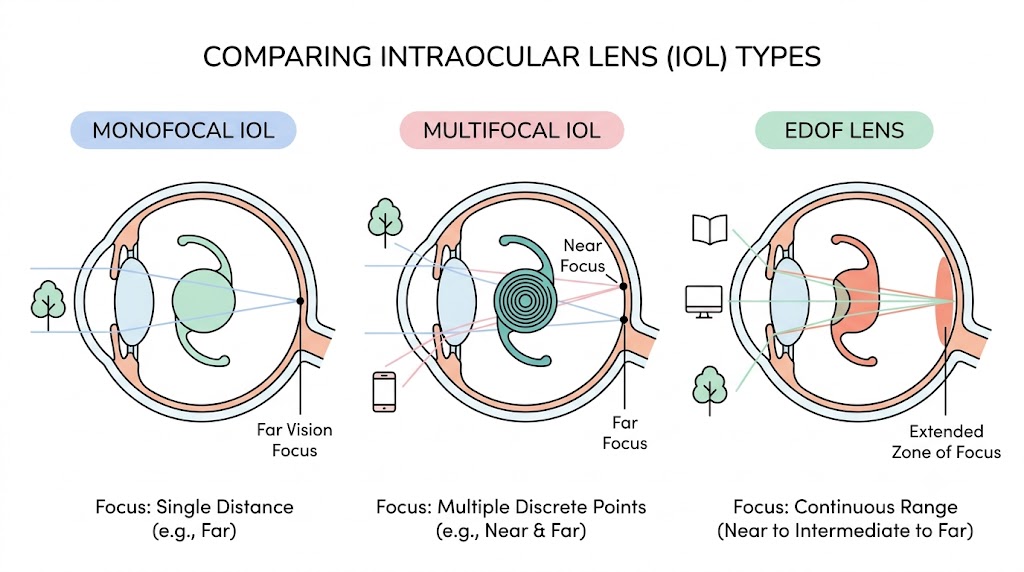
| Category | Monofocal IOL | Multifocal IOL (PanOptix-type, etc.) | EDOF Lens |
|---|---|---|---|
| Focal range | Focused mainly on distance; reading glasses needed for near vision | Aims to provide combined near, intermediate, and distance vision | Extended depth of focus, centered on intermediate and distance vision |
| Dependence on reading glasses | High | May be reduced (varies by individual) | Moderate |
| Possibility of nighttime glare | Relatively low | Because the lens creates several focal points at once, light is scattered, giving a relatively higher possibility of glare and halos than with monofocal lenses; however, this tends to ease as the brain gradually adapts. | Designed to produce less glare and light scattering than multifocal lenses, making it more favorable for lifestyles that involve frequent nighttime driving. |
| Cost level | Around ₩720,000–2,000,000 (varies depending on the surgical method and whether astigmatism correction is included) | Around ₩3,000,000–7,000,000 (based on premium lenses such as PanOptix Pro) | Around ₩3,000,000–5,000,000 |
Monofocal IOL
The standard lens that has been used the longest, offering stable distance vision and a relatively lower possibility of nighttime glare. However, reading glasses are needed for near-vision tasks in most cases.
Multifocal IOL (PanOptix-type, etc.)
Designed to cover near, intermediate, and distance vision together, with the aim of reducing how often reading glasses are needed. However, the possibility of nighttime glare or reduced contrast sensitivity should also be taken into consideration.
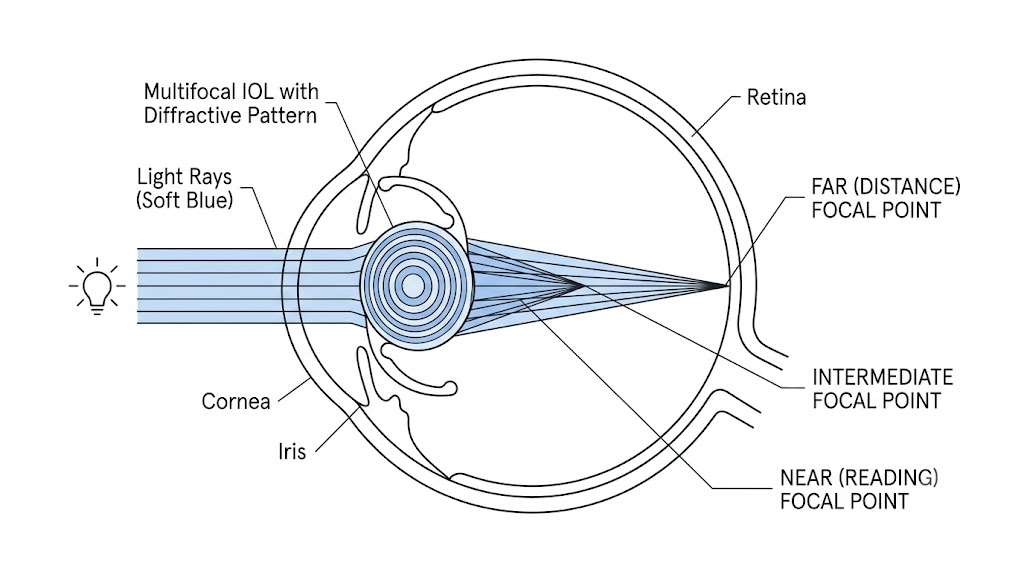
For 1–3 months after multifocal lens surgery, you may experience light spreading or halos around lights, but this generally improves as the brain undergoes a process of neural adaptation. In particular, the 'PanOptix Pro' lens introduced by Gangnam Seoul Bright Eye Clinic (강남서울밝은안과) is regarded as improving intermediate-distance vision (around 60cm, the distance most relevant to daily life in Korea) and increasing contrast sensitivity, reducing the discomfort of nighttime glare compared with earlier multifocal lenses.
EDOF (Extended Depth of Focus) Lens
A design that sits between monofocal and multifocal lenses, extending intermediate-distance vision while having a relatively simpler optical structure than multifocal lenses. The improvement in near vision may be more limited than with multifocal lenses.
If You Only Want Simple Vision Correction (Differences from LASIK, LASEK, and ICL)
If you do not yet have presbyopia or cataracts and only want to correct simple refractive errors such as nearsightedness, farsightedness, or astigmatism, it may be more appropriate to first refer to an article comparing vision correction methods such as LASIK, LASEK, SMILE, and ICL, rather than intraocular lens implantation. These two groups of procedures differ in the age groups they apply to and in their underlying principles, so they should not be confused.
👉 Wondering which procedure is right for you if you want to correct nearsightedness or astigmatism without presbyopia or cataracts? Check out our LASIK, LASEK, SMILE & ICL comparison guide!
4. Things to Consider: Risks, Side Effects, and When This Procedure May Not Be Right for You
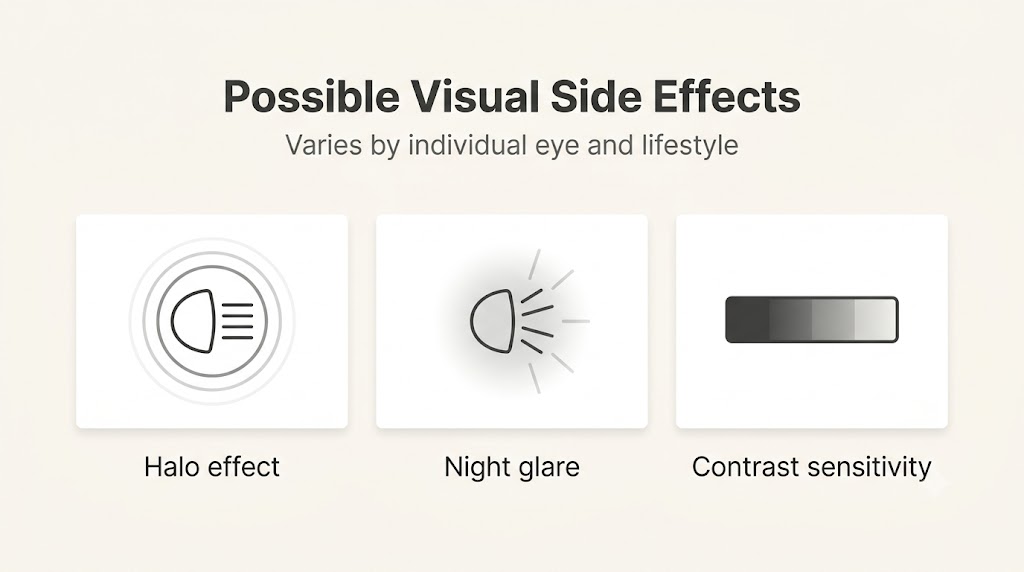
Because multifocal IOLs are designed to create several focal points at the same time, side effects such as nighttime glare (glare and halos—light spreading around light sources or circular rings appearing around them) and reduced contrast sensitivity (a feeling that the edges of objects are blurred) may occur.
The exact frequency and severity vary from person to person. For 1–3 months after multifocal lens surgery, light spreading or halos may be experienced, but these are generally known to improve as the brain undergoes neural adaptation. However, because the degree of improvement can vary from person to person, absolute statements such as "glare is almost nonexistent" should be avoided.
Individuals with a history of macular degeneration, severe glaucoma, or retinal detachment, or those with significant corneal opacity, irregular astigmatism, abnormal pupil size (extremely large or small), or severe dry eye, may not achieve clear vision even with a multifocal lens, and may therefore be excluded as candidates for surgery. The health of the retina and optic nerve is an important factor in this determination.
For those who drive frequently at night or have jobs or lifestyles that make them particularly sensitive to glare, a monofocal or EDOF lens may be more suitable, and the final decision should always be made based on thorough pre-operative examination and consultation.
Possible Optical Side Effects of Multifocal Lenses
Nighttime glare and reduced contrast sensitivity are the most commonly reported side effects.

This is reported to improve over time in some cases. You may notice glare or light sensitivity for 1–3 months after multifocal lens surgery, but premium lenses such as the 'PanOptix Pro' introduced by Gangnam Seoul Bright Eye Clinic are regarded as increasing contrast sensitivity and reducing nighttime glare compared with earlier multifocal lenses.
Exclusions and Contraindications
Multifocal lenses may not be recommended for those with retinal conditions such as macular degeneration, severe corneal disease, or certain pupil sizes.
🚨 Cases Where Multifocal Lens Implantation May Not Be Recommended
If you have a condition that structurally interferes with light being clearly focused on the retina—such as progressive macular degeneration, severe glaucoma accompanied by optic nerve damage, or severe corneal opacity or keratoconus—you will be excluded as a candidate for surgery. Whether any of these conditions apply must be confirmed through pre-operative examination.
Lifestyles for Which This Method May Not Be Suitable
If you have a job that involves frequent nighttime driving, or work in an environment that requires precise night vision, it is safer to first consider a monofocal lens or other alternatives.
5. Getting Treatment in Korea: Cost, Duration, Number of Visits, and Recovery
The number of visits and length of stay needed—from pre-operative examinations through follow-up care—vary depending on individual test results and whether surgery is performed on one or both eyes. Costs vary significantly depending on the surgical method and lens type: standard, Zepto, and laser-assisted monofocal lenses cost around ₩720,000–2,000,000 per eye (unilateral), while premium multifocal IOLs that correct cataracts and presbyopia at the same time, such as PanOptix Pro, are not covered by national health insurance and cost around ₩3,000,000–7,000,000 per eye, or around ₩6,000,000–14,000,000 for both eyes (bilateral). The surgery itself is relatively brief, taking around 15–30 minutes per eye, and it is standard to operate on each eye with an interval of one day to one week between them to prevent infection and stabilize vision. Return to daily activities is generally possible within a few days, but around 1–3 months of recovery is needed for vision to fully settle and for the brain to adapt to the multifocal lens.
Overseas Koreans and international patients considering surgery in Korea should check in advance whether the examination, surgery, and follow-up schedule can be completed in a single trip, or whether multiple visits will be needed. The required length of stay depends on whether one or both eyes are being treated and on the recovery process. Taking into account the safe scheduling of bilateral surgery, management of early post-operative infection and inflammation, and prevention of increased eye pressure due to changes in cabin air pressure during flights, a stay in Korea of at least 2–3 weeks is recommended.
Before your visit, thorough examinations—including corneal topography and axial eye length measurement—should be conducted, along with a review of any medications you are taking and any underlying conditions. If you have recent eye examination records from another country, it is a good idea to check in advance what languages the clinic can review and whether translation will be needed.
Expected Cost Range
The cost structure varies depending on lens type (monofocal, multifocal, or EDOF) and whether one or both eyes are treated. When reviewing a quote, be sure to check not only the lens cost but also whether pre-operative examinations, post-operative visits, prescription medication, and interpretation or international patient coordination services are included.
Monofocal lens surgery (standard, Zepto, laser-assisted, etc.) costs around ₩720,000–2,000,000 per eye (unilateral). Premium multifocal lenses that correct presbyopia and cataracts at the same time, such as PanOptix Pro, are not covered by national health insurance and cost around ₩3,000,000–7,000,000 per eye, or around ₩6,000,000–14,000,000 for both eyes (bilateral).
💡 Support Provided When Arranged Through SafeDoc
When arranged through SafeDoc, dedicated coordinator support—including schedule management and medical interpretation—is provided as part of tailored services for international patients, making the process more comfortable.
Number of Visits and Examinations Before and After Surgery
The total number of visits needed—for pre-operative examinations, the day of surgery, and post-operative follow-up—varies from person to person, but on average patients visit the eye clinic around 4–5 times in total: one visit for pre-operative examination, two visits for surgery on each eye, and one to two visits for post-operative follow-up and disinfection.
Overseas Koreans and international patients should be given clear guidance distinguishing between the follow-up care that must be done in Korea and the care that can be continued at a local eye clinic after returning home. One-on-one English and multilingual medical interpretation is provided through a dedicated coordinator, and English-language diagnosis reports, surgical records, and test results can be issued so that follow-up care can safely continue at a nearby eye clinic after returning home. In addition, if questions arise during the recovery process after departure, follow-up consultation with the treating physician and the clinic is supported through online channels.
Recommended Length of Stay and Recovery Process
If both eyes are treated sequentially, the length of stay in Korea may increase. To prevent infection, surgery on the two eyes is performed sequentially with an interval of one day to a few days between them, and to manage early post-operative inflammation and avoid the risk of increased eye pressure from cabin air pressure changes during flights, a stay in Korea of at least 2–3 weeks from the start of surgery is recommended.
Before booking flights, it is best to first coordinate the full schedule with the clinic or coordinator, including the date of pre-operative examination, the surgery schedule for both eyes, and the final follow-up appointment before returning home.
❓ Frequently Asked Questions (FAQ)
Q. Can multifocal IOLs address both presbyopia and cataracts at the same time?
Inserting a multifocal lens during cataract surgery aims to remove the clouded lens while also improving the reduced near vision caused by presbyopia, but the results can vary depending on the individual's eye condition.
- Cost: Monofocal surgery costs around ₩720,000–2,000,000 per eye depending on the method. The latest premium multifocal IOL surgery that corrects both cataracts and presbyopia is not covered by national health insurance and costs around ₩3,000,000–7,000,000 per eye, or around ₩6,000,000–14,000,000 for both eyes.
- Suitability is determined through pre-operative examination.
Q. Can there be glare while driving at night after multifocal lens implantation?
Because of the optical design of multifocal lenses, which create several focal points at once, there is a possibility of nighttime glare (glare and halos), and the degree varies from person to person.
- Due to the structure of multifocal lenses, you may experience glare or light sensitivity for the first 1–3 months after surgery. However, next-generation premium lenses such as 'PanOptix Pro' increase contrast sensitivity and minimize glare, improving safety during nighttime activities. Most patients experience little significant discomfort once the adaptation period has passed.
- Those who drive frequently at night should discuss this separately during consultation.
Q. How long should I stay when traveling from abroad to Korea for this surgery?
The exact length of stay depends on the examination, surgery, and follow-up schedule, and on whether one or both eyes are treated. If both eyes are treated sequentially, the length of stay may increase, so it is best to confirm the full treatment schedule before booking flights and accommodation.
- Recommended length of stay: at least 2–3 weeks in Korea from the start of surgery.
- Total number of visits: on average around 4–5 visits, including pre-operative examination, surgery on both eyes, and follow-up care.
- English and multilingual consultation and interpretation support: one-on-one English and multilingual medical interpretation is provided through a dedicated coordinator.
- Issuance of English-language diagnosis reports and test results: support is provided for issuing English-language documents for follow-up care at a local clinic after returning home.
- The visit schedule can be coordinated in advance through online consultation.
Q. Are there cases where multifocal IOLs are not suitable?
For certain eye conditions or lifestyle patterns, a monofocal lens or another alternative may be recommended over a multifocal lens.
- Exclusion criteria: candidates may be excluded from surgery if they have conditions such as progressive macular degeneration, severe glaucoma, or severe corneal opacity or keratoconus.
- Suitability must be determined through pre-operative examination.
Q. What if I don't have presbyopia or cataracts and just want simple vision correction?
If you do not yet have presbyopia or cataracts, refractive correction procedures such as LASIK, LASEK, SMILE, or ICL may be more suitable than multifocal IOLs.
- Refer to a separate article for a comparison of alternative procedures.
- The appropriate procedure differs depending on your age and corneal condition.
6. Next Steps: Preparing for Consultation and Booking
Before deciding whether to proceed with surgery, the first step is to check your suitability for each lens type based on the results of a thorough eye examination. Since exact costs and scheduling can vary depending on the examination results, it is a good idea to share your current eye condition and preferred schedule before finalizing your trip to Korea.
Overseas Koreans and international patients can receive more specific scheduling guidance by providing information such as their country of residence, preferred consultation language, available length of stay in Korea, and whether they wish to have one or both eyes treated.
What to Prepare Before Your Visit
- Recent eye examination records, test results, and prescription history
- Information on current medications and underlying conditions
- Recent corneal topography or axial eye length measurements, if available
- Frequency of nighttime driving and proportion of near-vision tasks in daily life
- Preferred visit date and available length of stay in Korea
- Whether you wish to have one or both eyes treated
- Language needed for consultation and interpretation
- Medical documents needed after returning home, such as English-language diagnosis reports and test results
- Whether translation of overseas medical records into English or Korean is needed
Connecting with SafeDoc for International Patient Consultation
Overseas Koreans and international patients considering cataract or vision correction treatment in Korea can first review clinic information on the Gangnam Seoul Bright Eye Clinic detail page, a clinic experienced in treating international patients.
If you would like to coordinate your visit schedule, estimated costs, examination items, pre- and post-operative visit plans, and the availability of English or multilingual consultation support, you can inquire through the SafeDoc coordinator pre-consultation channel. When you reach out, providing your current country of residence, preferred language, recent eye examination records, preferred visit date, and available length of stay in Korea will help you receive more specific guidance.