
What You Need to Know Before Wisdom Tooth Extraction: Side Effects, Precautions, and Anesthesia Options (2026)
First published: July 30, 2026 · Last updated: September 14, 2026
💡 Quick Summary: At a Glance
- What wisdom tooth extraction is: a dental procedure to surgically remove a third molar (wisdom tooth) that hasn't grown in properly because it's covered by gum tissue or jawbone.
- Extraction isn't always necessary: if the tooth has come in straight and functions normally, you don't need to remove it — but if there's pain, it's likely that a cavity or inflammation is already developing.
- Alternative when nerve damage risk is high: if the root sits close to the inferior alveolar nerve canal, coronectomy may be considered instead of complete extraction; side effects can include nerve damage, bleeding, swelling, and dry socket.
- Disclosure is essential beforehand: if you're pregnant, breastfeeding, or have a systemic condition or are taking medication, you must disclose this during consultation so the anesthesia and extraction method can be safely adjusted.
🎯 Who This Guide Is For: anyone weighing whether to have a wisdom tooth removed, and both Korean residents and international patients planning an extraction or coronectomy in Korea.
If Your Wisdom Tooth Hurts, Do You Have to Remove It?
Wisdom tooth extraction is a dental procedure to surgically remove a third molar (wisdom tooth) that hasn't grown in properly because it's covered by gum tissue or jawbone. If a wisdom tooth has come in straight and functions normally for chewing, like your other molars, you don't necessarily need to have it removed. But if pain has already started, there's a high likelihood that a problem — such as a cavity or inflammation — is already developing around the tooth. Pain is usually a sign that food debris and bacteria have built up in the gap between the wisdom tooth and the molar in front of it, triggering inflammation, and the longer it's left untreated, the more the problem can spread to surrounding tissue.
On the other hand, if an impacted wisdom tooth was found only during a routine checkup and isn't causing pain, it's also possible to choose to monitor it rather than extract it right away. That said, the direction of impaction and the distance from the nerve canal can't be accurately determined without imaging such as a panoramic X-ray or CT scan, so regardless of whether there's pain, it's safer to have it checked at least once by an oral and maxillofacial surgery specialist.
When a Normally Impacted Wisdom Tooth Doesn't Need Removal
If a wisdom tooth has grown in straight, meets its opposing molar normally to function in chewing, and sits in a position you can keep clean with brushing, it may be kept without extraction.
What It Means When Pain Starts
If the inner jaw or the area behind your molars becomes swollen or painful, it's likely more than simple sensitivity — a cavity or inflammation may already be developing — so it's best not to ignore it and to get it checked.
4 Problems That Can Arise from Delaying Extraction
There are four main problems that can arise from delaying extraction. First, bacteria can multiply in the gap between the wisdom tooth and the neighboring molar, causing repeated cavities and inflammation. Second, a cyst (an odontogenic cyst) can occasionally form around the wisdom tooth tissue, which may press on the nerve canal or, in severe cases, weaken the jawbone. Third, when a horizontally impacted wisdom tooth continuously pushes against the root of the molar in front of it, it can cause external resorption — a shortening of that root — and in severe cases, it may be the neighboring molar, not the wisdom tooth, that ends up needing extraction. Fourth, over time the periodontal ligament (the cushioning ligament between a tooth and the bone) can degrade, causing the wisdom tooth root to fuse directly to the jawbone — a condition called ankylosis — which increases both the difficulty of later extraction and the risk of damage to nearby teeth.
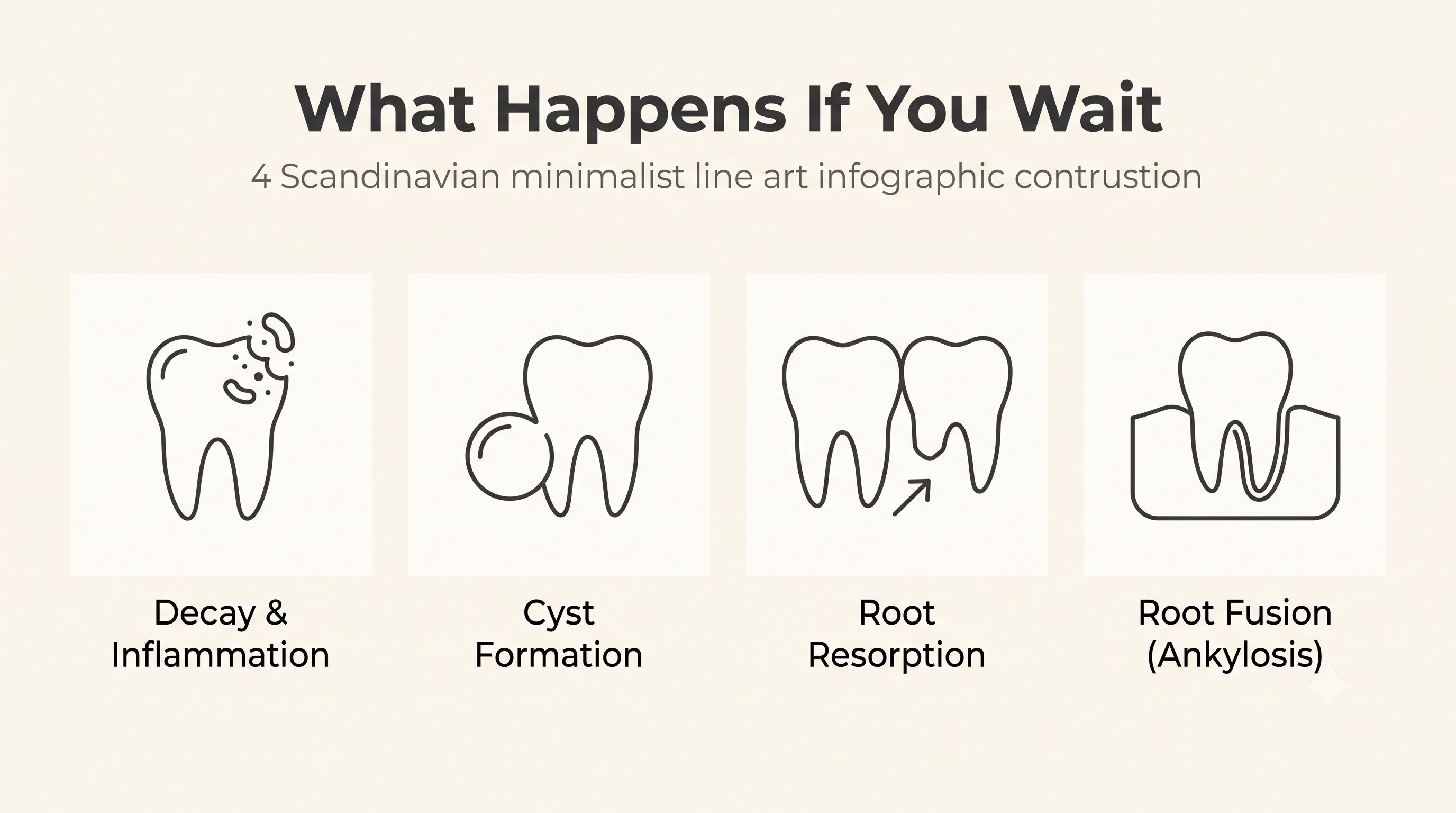
Cavities and Inflammation in Neighboring Teeth
The narrow gap between the wisdom tooth and the molar in front of it is hard to reach with a toothbrush, making it an easy spot for bacteria to build up.
Wisdom Tooth Cysts
These don't occur often, but when they do, they can lead to nerve canal compression or jawbone weakening, so early detection matters.
External Resorption of the Adjacent Molar
This is when a horizontally impacted wisdom tooth's continuous pressure on the root of the molar in front of it causes that root to shorten.
Ankylosis (Fusion to the Jawbone)
This is when the periodontal ligament disappears and the root fuses directly to the bone, making subsequent extraction significantly more difficult.
Extraction Methods and Anesthesia Options
How difficult an extraction is depends heavily on how much of the wisdom tooth has emerged through the gum, which direction it's lying in, and how much space surrounds it — the more severe the impaction, the more likely a surgical extraction is needed rather than a simple one. In particular, because the inferior alveolar nerve canal (the passage for the nerve responsible for sensation in the lower jaw) runs directly beneath the wisdom tooth, it's recommended that extractions in this area be performed by an oral and maxillofacial surgery specialist. If the root is very close to the nerve canal, coronectomy may be considered instead of complete extraction.
Complete Extraction vs. Coronectomy
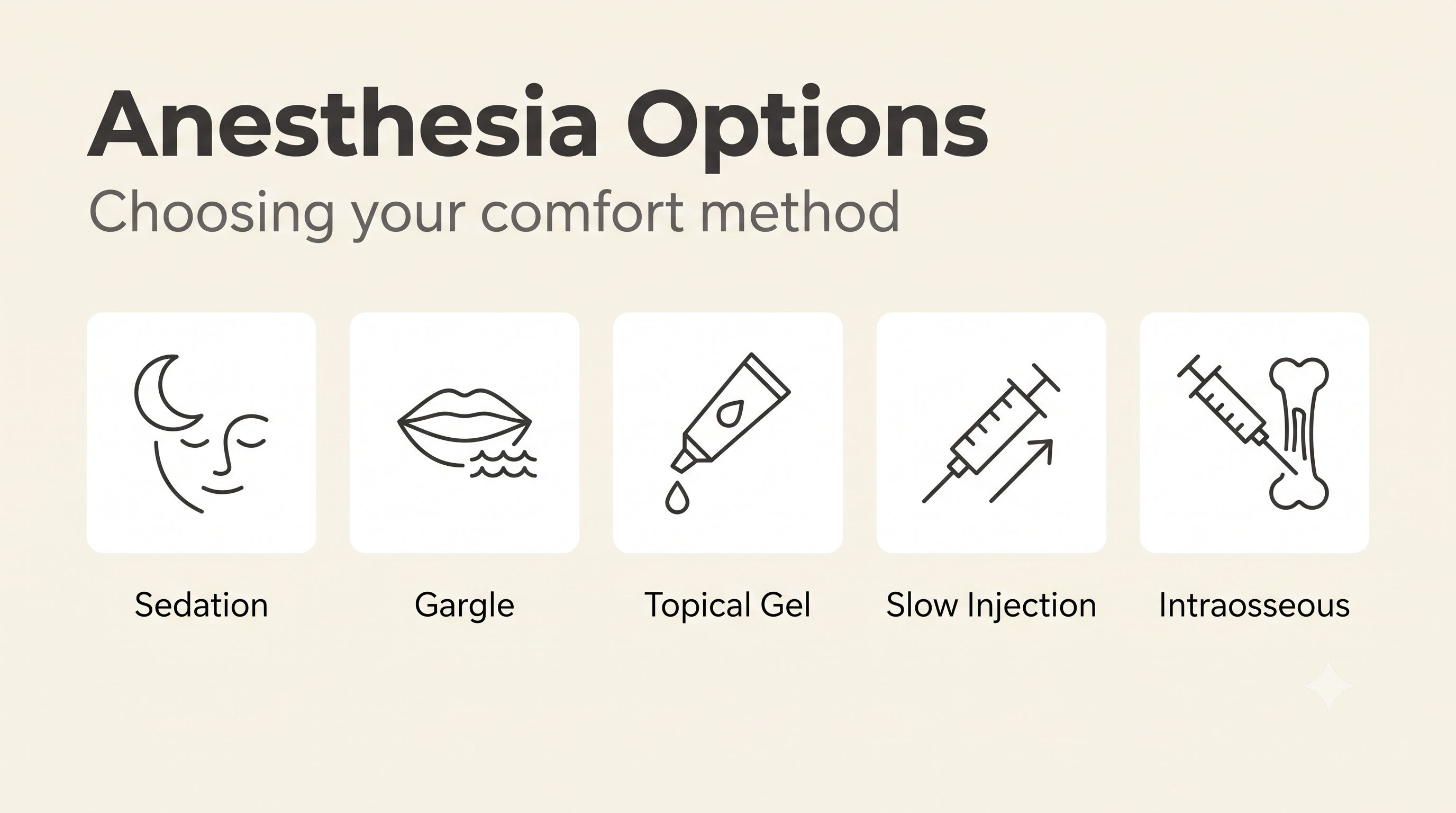
If the distance between the root and the nerve canal is within a safe range, complete extraction — removing the entire tooth (crown and root) at once — is the standard approach. But if the root is judged to be very close to the nerve canal, raising the risk of nerve damage with complete extraction, coronectomy is chosen instead: only the crown (the top of the tooth) is removed first, the root is left in place to naturally migrate away from the nerve canal over time, and it's removed later in a second procedure if needed.
| Category | Complete Extraction | Coronectomy |
|---|---|---|
| Who it's for | Cases where the depth of impaction and distance from the nerve canal are within a safe range | Cases where the wisdom tooth root is very close to the inferior alveolar nerve canal |
| Surgical approach | The entire tooth (crown + root) is removed at once | Only the crown is removed first; the root is left to migrate away from the nerve canal, then removed later if needed |
| Nerve damage risk | Relatively higher when the root is close to the nerve canal | Designed to reduce nerve canal irritation and lower the risk |
| Visits & follow-up | Standard follow-up after extraction | A follow-up visit is needed 1–2 weeks later to check the gums and remove stitches, and regular checkups every 3–6 months are recommended to confirm the remaining root is safely migrating away from the nerve |
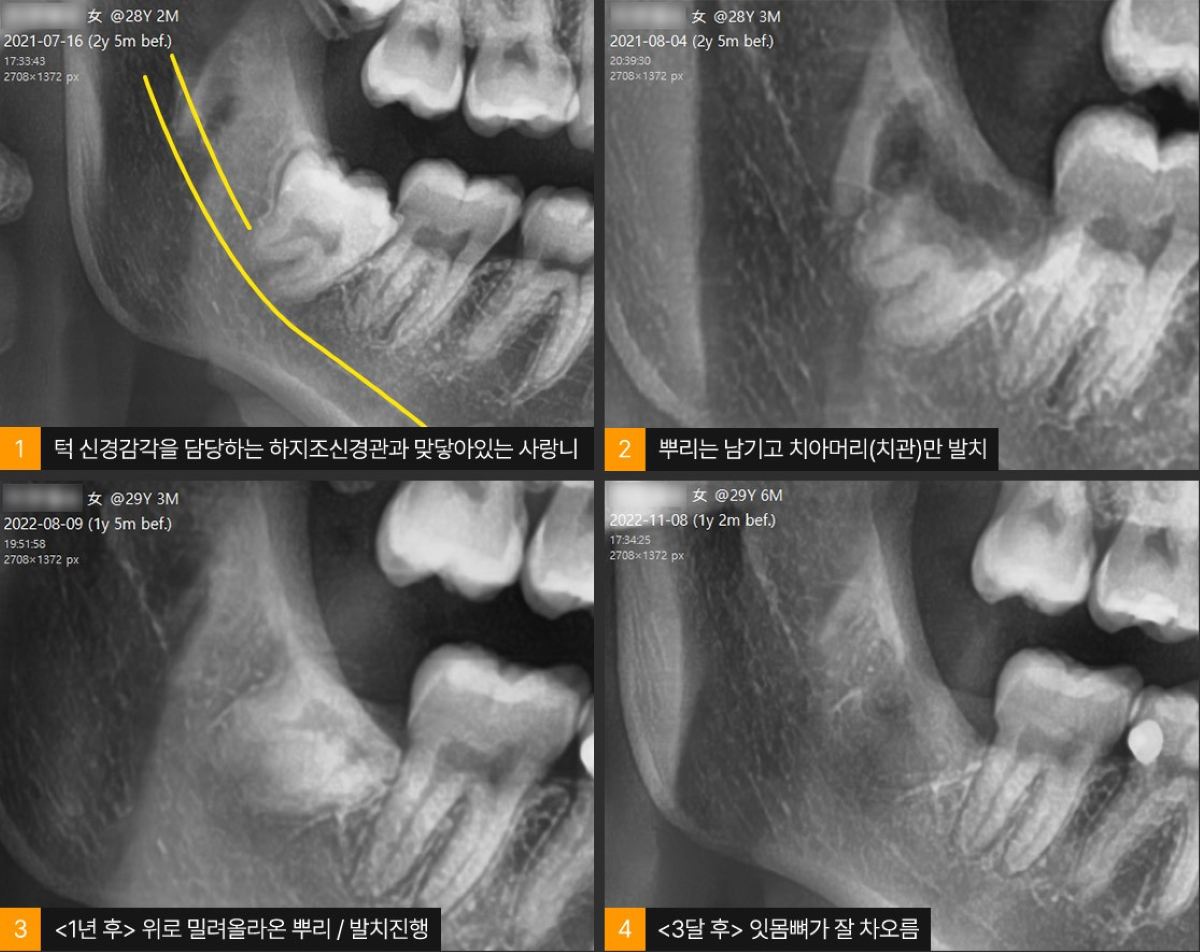
Comparing 5 Types of Anesthesia (Sedation, Gargle, Topical, Painless, Intraosseous)
| Anesthesia Type | Characteristics | Best Suited For |
|---|---|---|
| Sedation anesthesia | Performed in a light, sleep-like state in which you can still communicate | Patients with dental anxiety |
| Gargle anesthesia | A topical rinse held in the mouth | When you want to lightly numb local sensation |
| Topical anesthesia | A gel-type numbing agent applied to the gums before injection | When you want to reduce injection pain |
| Painless anesthesia | Medication is delivered slowly at low pressure | When you want to minimize pain |
| Intraosseous anesthesia | The anesthetic is injected directly into the bone | For those whose bodies don't respond well to standard anesthesia; not every clinic offers this, so check in advance |
If You're Planning Orthodontic Treatment: Cases Where the Wisdom Tooth Is Preserved
If orthodontic treatment is planned and a neighboring tooth is already missing, an impacted wisdom tooth may not be extracted right away — instead, it may be gradually pulled into position with orthodontics to serve as a substitute molar. In this case, preservation may be more advantageous than extraction, so coordination with an orthodontist is needed.
Considerations: Risks, Side Effects, and When Extraction Is Difficult
There are situations where wisdom tooth extraction isn't suitable, or where extra caution is required. If the root is very close to the inferior alveolar nerve canal, raising the risk of complete extraction; if the root and jawbone are severely fused (ankylosis); or if you're pregnant, breastfeeding, taking certain medications, or have a systemic condition, the anesthesia and extraction method may need to be adjusted, or the timing delayed.
💡 Precautions for Pregnancy, Breastfeeding, and Medication
If you are pregnant (the stable second trimester, weeks 14–28, is recommended) or breastfeeding, caution is needed with anesthetics and prescribed medications. If you're taking osteoporosis medication, your jawbone may not heal well, so you may need to pause the medication beforehand; if you have high blood pressure or diabetes, or are taking a blood-thinning medication such as aspirin, extraction proceeds only after your medication is adjusted and reviewed in consultation.
The most significant risk is nerve damage: if a complete extraction is attempted while the root is pressing on or lying close to the nerve canal, it can cause numbness in the lower jaw, lip, or tongue. In this situation, coronectomy — removing only the crown and leaving the root — is considered as a way to reduce nerve irritation. Beyond this, bleeding, swelling, and temporary pain are common after extraction, and in rare cases, a complication in which a blood clot fails to form properly at the extraction site, leading to prolonged pain, has also been reported.
Nerve Damage Risk and How Coronectomy Reduces It
The closer the root is to the nerve canal, the greater the risk of nerve damage with complete extraction, and in such cases, coronectomy — which reduces irritation of the nerve canal — can be an alternative.
Common Side Effects After Extraction
🚨 Symptoms That Require Immediate Contact With Your Clinic
If you experience bleeding that won't stop even with gauze pressure, swelling or breathing difficulty that worsens over time, a fever of 38°C or higher, or numbness in the lips or jaw that doesn't resolve, don't wait for your scheduled appointment — contact the clinic where you had the extraction, or an emergency room, right away.
On the other hand, mild pain, slight swelling, and small amounts of discharge are fine to have checked at your regularly scheduled follow-up.
💡 What Is Dry Socket?
Dry socket is a side effect in which a blood clot fails to form properly, or falls out too early, at the extraction site, leaving bone exposed and causing severe pain and odor — it occurs in about 2–5% of cases. It can't be treated at home, so if the pain is severe, you should visit the dental clinic right away for disinfection and pain management.
Without proper post-extraction recovery care, pain can last longer than expected, so it's recommended to pay close attention to recovery care and dry socket prevention after extraction.
When a Consultation With an Oral and Maxillofacial Surgery Specialist Is Essential
If the direction of impaction is unclear, if the measured distance to the nerve canal is close, if ankylosis is suspected, or if you have a systemic condition or are taking medication, imaging review and diagnosis by an oral and maxillofacial surgery specialist should take priority over routine care.
Getting Wisdom Tooth Extraction in Korea: Cost, Timeline, Visits, and Recovery
If you're planning to have a wisdom tooth extracted in Korea, there are three things to check beforehand. First, the exact cost varies significantly depending on the degree of impaction, so check the estimated price range before your consultation. Second, the basic process involves one consultation (including imaging) and one extraction visit, but choosing coronectomy may add follow-up visits for root removal. Third, a simple extraction can be done on the same day and typically wraps up with 1–2 days of ice packs at home, but if impaction is severe or you undergo surgical extraction or coronectomy, the total recovery time varies from person to person. If you're traveling from abroad, you should also consider the schedule between your consultation and extraction dates, and whether long-distance travel right after extraction would be too demanding on your recovery.
Cost Ranges
| Extraction Type | Cost (SAFEDOC Fee Standard) |
|---|---|
| Non-incision / simple extraction | Approx. ₩150,000–250,000 |
| Incision / partial-impaction extraction | Approx. ₩250,000–350,000 |
| Complete/bony-impaction surgical extraction | Approx. ₩350,000–500,000 |
💡 Additional Anesthesia Costs
Basic gum anesthesia is included in the extraction fee. Adding painless (intraosseous) anesthesia costs an extra ₩30,000–50,000, and adding sedation anesthesia — for a comfortable, sleep-like experience — costs an extra ₩150,000–300,000.
When comparing quotes, always confirm whether imaging, extraction, anesthesia, and follow-up visits are included in the price.

Number of Visits and Length of Stay
The basic process is 1 consultation + 1 extraction visit, and choosing coronectomy may add follow-up visits. Most patients visit a total of 2–3 times.
- Visit 1: examination, X-ray/CT imaging, and extraction
- Visit 2: disinfection and follow-up check
- Visit 3: stitch removal a week later
The recommended length of stay for international patients is a minimum of 5 to 7 days, since bleeding needs to be confirmed as fully stopped and stitches need to be cleanly removed a week later. You should also check in advance whether English-language consultation or interpretation support is available.
Before your visit, it's a good idea to check the degree of impaction and nerve canal position via panoramic or CT imaging, and if you want intraosseous anesthesia, to confirm in advance whether the clinic has the necessary equipment. Some clinics differ in whether an oral and maxillofacial surgery specialist is on staff or in what interpretation support they offer, so checking clinic details beforehand can save time on the day of your visit. For example, Yonsei Good Day Dental Clinic (연세굿데이치과) Suseo Branch has an oral and maxillofacial surgery specialist on staff who safely performs high-difficulty impacted wisdom tooth extractions and coronectomies, and as a designated institution for international patients, it offers 1:1 English interpretation and a patient guidance system.
👉 Curious whether this clinic has an oral and maxillofacial surgery specialist on staff and what interpretation support is available? Check details on Yonsei Good Day Dental Clinic Suseo Branch
6 Recovery Care Rules After Extraction
Bleeding and throbbing pain on the day of extraction can largely be reduced by following a few care guidelines.
- Swallow any blood or saliva that pools in your mouth rather than spitting it out.
- Bite down on gauze for about 2 hours to stop bleeding.
- On the day of extraction, eat only cold, soft foods, and avoid using straws.
- Avoid alcohol and smoking.
- Avoid strenuous exercise or activities that raise body temperature, such as saunas.
- Applying ice for 1–2 days after returning home helps reduce swelling.

❓ Frequently Asked Questions (FAQ)
Q1: If my wisdom tooth doesn't hurt, can I skip removing it?
If it has grown in straight and functions normally, you don't necessarily need to remove it — but if you're already experiencing pain, there's a high likelihood that a problem is already developing around the tooth.
- 4 problems that can arise if left untreated: cavities/inflammation, cysts, external resorption, ankylosis
- A dental visit and imaging are needed for an accurate assessment.
Q2: Is there a risk of nerve damage from wisdom tooth extraction?
If the root of an impacted wisdom tooth is close to the inferior alveolar nerve canal, forcing a complete extraction can cause nerve damage that numbs sensation in the jaw.
- When risk increases: when the root and nerve canal are very close together
- Alternative: coronectomy, which removes only the crown first
- Imaging and consultation with an oral and maxillofacial surgery specialist are essential.
Q3: Will the anesthesia hurt? Which type should I choose?
Using topical anesthesia together with painless anesthesia helps minimize pain, and sedation anesthesia can be considered if you have significant dental anxiety.
- 5 types of anesthesia: sedation / gargle / topical / painless / intraosseous
- Intraosseous anesthesia isn't available at every clinic, so check in advance.
- Basic gum anesthesia is included in the extraction fee; painless (intraosseous) anesthesia adds about ₩30,000–50,000, and sedation anesthesia adds about ₩150,000–300,000.
Q4: How many days of recovery are needed after extraction?
On the day of extraction, bite on gauze for about 2 hours and apply ice for 1–2 days; the point at which you can fully return to normal activity depends on the degree of impaction.
- Day of extraction: about 2 hours of gauze pressure, cold and soft foods, no straws/alcohol/smoking
- 1–2 days: ice packs, no strenuous exercise or saunas
- A non-incision simple extraction allows a return to normal daily life the next day, while incision surgery or a fully impacted extraction calls for 2–3 days of adequate rest.
Q5: Can I get wisdom tooth extraction while traveling? How many visits are needed?
At least 1–2 visits are needed for consultation (including imaging) and extraction, and choosing coronectomy may require additional follow-up visits.
- Visit 1: imaging and consultation
- Visit 2: extraction
- A stay of 5–7 days is recommended, with a total of 2–3 visits: an initial disinfection check 1–2 days after extraction, and stitch removal 7 days later.
Next Steps
What to Prepare Before Booking a Consultation
Before your visit, check whether you have a recent panoramic or CT scan, and if not, ask in advance whether imaging can be taken on the day of your consultation. If you're taking any medication or have a systemic condition, you must disclose this during your consultation so it can factor into the choice of anesthesia and extraction method. If you're unsure whether you need extraction or which anesthesia to choose, you can ask a question on WhatsApp in advance to explain your situation and get the information you need before booking.
Considering Related Procedures Together
If you're planning other dental procedures alongside wisdom tooth extraction during your visit to Korea, it can also help to coordinate your schedule and recovery time for both.
👉 Also planning veneers along with your wisdom tooth extraction? Check out veneer types, costs, and side effects