
Facelift in Korea: Cost, Recovery Time and How Long to Stay
Published: 2026-11-23
A facelift is surgery that lifts and tightens sagging facial skin and the layer beneath it (the SMAS, a thin layer that covers the facial expression muscles), then removes the extra skin. It is used to reduce sagging cheeks, loose skin below the jawline and the deep fold running from beside the nose to the corners of the mouth, and it is often combined with a neck lift. This guide covers, in order, what patients from abroad looking into a facelift in Korea usually want to know first: the cost and types of surgery, how many days to stay in Korea after surgery, and the risks to check before surgery.
💡 Quick Summary: At a Glance
- What it changes: It reduces sagging such as drooping cheeks, loose skin below the jawline and deep smile lines (nasolabial folds). A facelift does not change fine lines, sun damage to the skin, fine lines around the nose and upper lip, or changes in skin color.
- Check first: You cannot have the surgery if you have a condition that stops your blood from clotting normally. You may be told to stop blood-thinning medicine, aspirin or ibuprofen, supplements such as ginkgo, ginseng and fish oil, and hormone replacement therapy (hormone medicine used for menopause symptoms) about 3 weeks before surgery, so discuss this in advance with the doctor who prescribed them. Smoking greatly raises the risk of wound-healing problems and skin necrosis (death of skin tissue), and poorly controlled diabetes or high blood pressure also raises the risk.
- Length of stay: Stitches are often removed 7–14 days after surgery (up to 3 weeks depending on the surgeon), and the American Society of Plastic Surgeons (ASPS) and the UK's National Health Service (NHS) advise not flying for 7–10 days after facial cosmetic surgery. You can only fly home once your stitches are out and the no-flying period is over, so allow about 2 weeks or more including 1–2 days before surgery, and let the clinic set your return date after checking how you are healing.
- Cost: Based on the SafeDoc price (as of 2026-11-04), a mini lift costs ₩8,000,000 (about $5,517), a facelift ₩12,000,000–₩17,600,000 (about $8,276–$12,138) and a face and neck lift ₩16,000,000 (about $11,034). Whether anesthesia, hospital stay and tests are included must be checked with each clinic.
- Recovery: Swelling and bruising are worst on days 3–4, and bruising lasts at least 2 weeks. Many people return to light activities such as work and walking at about 2 weeks, and the final result shows after 6–9 months.
🎯 Who This Guide Is For: People living abroad who are considering a facelift in Korea and want to compare costs by type of surgery, how long they need to stay in Korea and the risks before planning their trip.
What Is a Facelift in Korea, and Who Is It For?
A facelift lifts and secures not only the skin but also the tissue and the SMAS layer beneath it, so what it can change is different from lasers or lifting devices that work on the skin surface. In the Ministry of Health and Welfare's 2025 figures by department, plastic surgery accounted for 233,100 (11.2%) of the international patients who came to Korea. A facelift suits people whose sagging in the cheeks, jawline and neck is noticeable, whose health allows them to undergo surgery, and who do not smoke. On the other hand, if your main concern is skin texture, fine lines or pigmentation, a facelift will not solve it and other treatments should be considered. If your weight often goes up and down, the shape of your face and your skin change with it, which can lower your satisfaction with the result. What patients from abroad especially need to know is that a facelift is not a procedure you can fly home from the day after surgery. You have to wait until your stitches are out, your progress has been checked and it is safe to fly, so you need to plan to stay in Korea for about 2 weeks or more in total, before and after surgery. The results are also not lifelong. Your face keeps aging after surgery, so it can sag again over time.
How Is a Facelift Done? Incision Lines and the Surgical Process
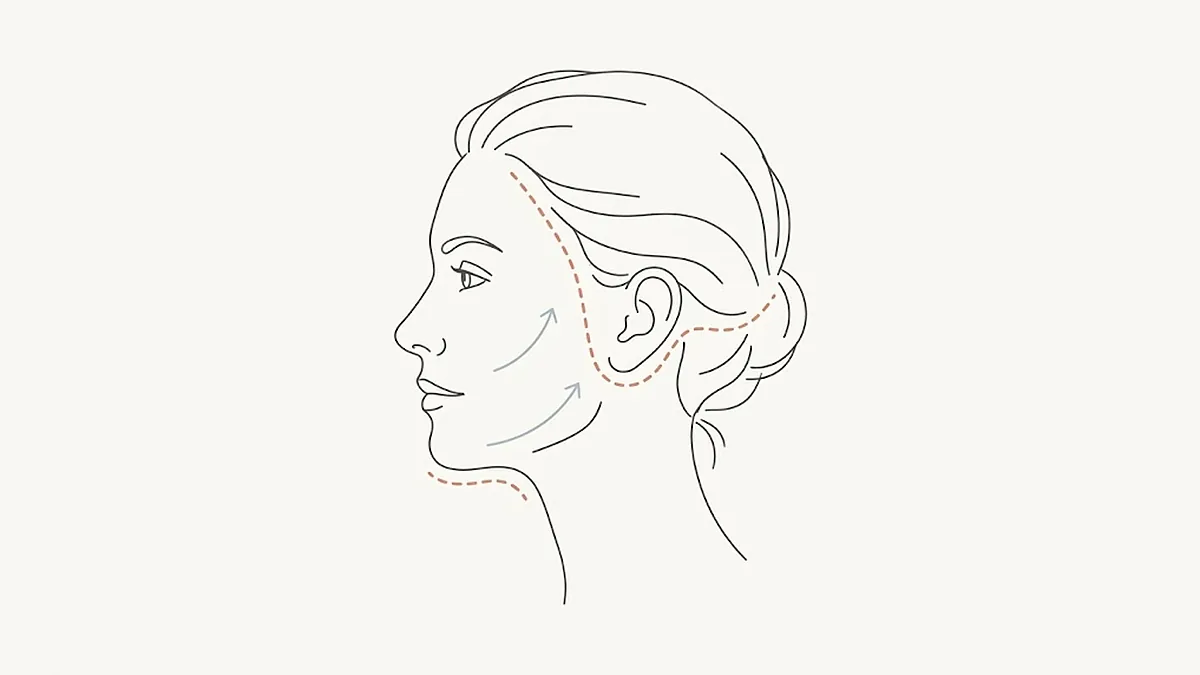
Facelifts differ by where the incisions are made and how much is lifted, and this affects where the scars are and the cost. A traditional facelift incision starts in the hairline at the temple, runs down in front of the ear, goes around behind the ear and ends in the lower scalp. A shorter incision starts in the hairline just above the ear and wraps around the front of the ear but does not continue into the lower scalp, and when the neck is treated as well, a small incision is added under the chin. The surgeon lifts the skin, then tightens and secures the tissue and muscles beneath it, moves or reduces facial fat if needed, and then redrapes the skin and removes the extra. Before surgery, the medical team checks your medical history and medicines, takes facial photos, and looks at your bone structure, face shape, fat and skin. Anesthesia is either sedation combined with local anesthesia or general anesthesia, and surgery usually takes 2–6 hours, longer if other procedures are done at the same time. A thin tube to drain blood and fluid is often placed behind the ear and removed the next day; the NHS says most people stay in hospital overnight, and the medical team decides whether you can go home the same day. The scars are permanent but mostly hidden by the hairline and the contours around the ear.
Comparing Options: Mini Lift, Facelift, Neck Lift, Forehead Lift and Non-Surgical Lifting
Facelift surgery itself is divided by the area that is lifted, and if sagging is mild, non-surgical lifting can be considered first instead of surgery. A mini lift uses a shorter incision that starts in the hairline just above the ear and wraps around the front of the ear without continuing into the lower scalp, and how much it can address and whether it suits you are confirmed at the consultation. A facelift lifts the skin and the SMAS layer together to treat sagging in the cheeks and jawline, and adding a neck lift also tightens loose skin and muscle in the neck. A forehead and brow lift targets the forehead and eyebrows, and a midface lift targets the area under the eyes and the upper cheeks, but surgical methods vary by clinic, so the incision site and the area treated need to be confirmed at the consultation. Skin-tightening treatments such as ultrasound and radiofrequency involve less recovery, but the American Academy of Dermatology explains that surgery such as a facelift gives the biggest change and that less invasive methods cannot give the results of surgery. These treatments may suit people with a small amount of sagging, and if there is a lot of sagging they may not be enough. Thread lifts are another option people compare, with less recovery than surgery. Having other surgery at the same time also raises the risk of complications, so which surgery suits you is decided at the consultation based on where and how much you are sagging, your skin condition and any other surgery you plan to have.
| Option | Area treated | Consider when | Things to consider |
|---|---|---|---|
| Mini lift | Lower cheeks and jawline (per clinic information) | You want a shorter incision | Confirm what it can address and whether it suits you at consultation. The length-of-stay and flying rules are the same as for a facelift |
| Facelift | Cheeks and jawline (skin + SMAS layer) | Clear sagging in the cheeks and jawline | You need to stay until your stitches are out and you can fly |
| Face + neck lift | Cheeks, jawline and neck | Skin and muscle in the neck are also loose | Wider area so the cost is higher, and the neck loses the most improvement over time |
| Forehead and brow lift | Forehead and eyebrows | Sagging forehead and brows are your concern | Incision site (endoscopic method, etc.) varies by clinic. Sagging in the lower face is treated separately |
| Midface lift | Under the eyes and upper cheeks (per clinic information) | Sagging under the eyes and in the upper cheeks is your concern | Confirm the incision site and surgical method at consultation. Does not treat jawline sagging |
| Non-surgical lifting (ultrasound, radiofrequency, thread lift) | Skin and tissue under the skin | Sagging is mild and you want less recovery time | Hard to get the same change as surgery, and may not be enough if there is a lot of sagging. Ask at the consultation whether there are reasons it may not suit you |
👉 Want to look into non-surgical options before surgery? Learn about thread lift costs in Korea and how long they last
Considerations: Risks, Side Effects, Limitations and Who Should Not Have It
⚠️ Be sure to tell the clinic before surgery if:
- You have a condition that stops your blood from clotting normally. You cannot have a facelift.
- You take blood-thinning medicine such as warfarin or clopidogrel, aspirin or ibuprofen, or supplements such as ginkgo, ginseng and fish oil. These raise the risk of a hematoma (blood collecting under the skin), and you may be told to stop them about 3 weeks before surgery. Discuss with the doctor who prescribed them whether to stop.
- You take hormone replacement therapy. It raises the risk of blood clots (lumps of clotted blood), and you may be told to stop it about 3 weeks before surgery.
- You smoke. The risk of wound-healing problems, hematoma and skin necrosis rises greatly.
- Your diabetes or high blood pressure is not well controlled. The risks of surgery rise.
- Your weight often changes a lot. Your satisfaction with the result may be lower.
After a facelift, pain, swelling, bruising and numbness are common, and the NHS says stiffness of the face and around the mouth usually improves within 6 weeks. The most common complication is a hematoma, which usually forms within 24 hours of surgery and needs treatment right away. In an Aesthetic Surgery Journal study of 11,300 patients who had a facelift, major complications that needed an emergency room visit, hospital admission or another operation within 30 days of surgery occurred in 1.8%, hematoma in 1.1%, and men had about 3.9 times the risk of hematoma compared with women. Major complications occurred in 1.5% of those who had a facelift alone, but rose to as much as 3.7% in those who had other surgery at the same time. In rare cases, the nerves that control facial feeling or muscle movement can be injured; when the injury is temporary, it lasts from a few months to about a year, but nerve injury can also be permanent. Temporary or permanent hair loss around the incisions, thinner hair at the temples, a change in the position of the hairline or sideburns, uneven sides of the face, thick scars, and skin necrosis caused by a blocked blood supply are also possible risks.
🚨 Contact the clinic that operated on you right away if:
- You develop severe pain on one side of the face or neck within 24 hours of surgery (a sign of hematoma)
- At any time, you become short of breath, have chest pain or have an irregular heartbeat

| Risk | Details |
|---|---|
| Common reactions | Pain, swelling, bruising, numbness, stiffness of the face and around the mouth (usually improves within 6 weeks), low mood for a few days |
| Hematoma | The most common complication. Usually forms within 24 hours and needs treatment right away. 1.1% in the study, about 3.9 times higher in men than in women |
| Nerve injury | Rare. Affects feeling or facial movement. If temporary, a few months to 1 year; can be permanent |
| Scars and hair changes | Scars are permanent and mostly hidden by the hairline and around the ear. Hair loss around the incisions, change in the position of the hairline or sideburns |
| Skin necrosis | Rare. Happens when blood supply is blocked; smoking raises the risk |
| General surgical risks | Bleeding, infection, blood clots in a vein, allergic reaction to anesthesia |
| Unsatisfactory result | If the result is not what you expected, you may need another operation, so check in advance how the cost would be handled |
The American Society of Plastic Surgeons warns that long flights and surgery each raise the risk of blood clots and pulmonary embolism (a blood clot blocking a blood vessel in the lungs), and that the risk is greater when the two are combined. If you become short of breath or have chest pain during or after your flight home, seek medical care right away.
👉 What does it mean if you are short of breath after a flight? Learn the symptoms of pulmonary embolism and when to go to hospital right away
If You Get Treated in Korea: Cost, Length of Stay and Recovery Timeline
The cost of a facelift in Korea depends on how much is lifted and the clinic. Based on the SafeDoc price (as of 2026-11-04) at 2 partner plastic surgery clinics, a mini lift costs ₩8,000,000 (about $5,517), a facelift ₩12,000,000–₩17,600,000 (about $8,276–$12,138), a face and neck lift ₩16,000,000 (about $11,034) and a full lift including the forehead ₩20,000,000 (about $13,793). A forehead and brow lift is listed at ₩6,600,000–₩7,000,000 (about $4,552–$4,828), a midface lift at ₩3,300,000 (about $2,276), and ₩4,400,000 (about $3,034) with under-eye fat grafting added. The platform lists only the consultation as included, so when you compare quotes, also check whether anesthesia, hospital stay, pre-surgery tests, post-surgery check-ups and stitch removal, and compression bands are included. For reference, the 2024 range for facelift costs in the US published by the American Society of Plastic Surgeons, based on a survey of its member surgeons, is $12,000–$19,000, but because what is included differs, it is hard to compare it directly with the SafeDoc price. For non-surgical lifting, a thread lift costs ₩2,750,000–₩3,000,000 (about $1,897–$2,069) and Ulthera (an ultrasound lifting device) 600 shots ₩3,080,000 (about $2,124).
Cost Range Table
| Item | Basis | KRW | USD |
|---|---|---|---|
| Mini lift | 1 surgery | ₩8,000,000 | $5,517 |
| Facelift | 1 surgery | ₩12,000,000 ~ ₩17,600,000 | $8,276 ~ $12,138 |
| Face + neck lift | 1 surgery | ₩16,000,000 | $11,034 |
| Full lift (including forehead) | 1 surgery | ₩20,000,000 | $13,793 |
| Forehead and brow lift | 1 surgery | ₩6,600,000 ~ ₩7,000,000 | $4,552 ~ $4,828 |
| Midface lift | 1 surgery | ₩3,300,000 | $2,276 |
| Midface lift + under-eye fat grafting | 1 surgery | ₩4,400,000 | $3,034 |
| Thread lift (non-surgical) | 1 session | ₩2,750,000 ~ ₩3,000,000 | $1,897 ~ $2,069 |
| Ulthera 600 shots (non-surgical) | 1 session | ₩3,080,000 | $2,124 |
Amounts are the SafeDoc price (as of 2026-11-04); USD figures are reference values at ₩1,450/USD and change with the exchange rate. The platform lists only consultation as included, and the final amount is confirmed at your consultation.
Length of Stay and Schedule
A facelift is a single operation, but how long you stay in Korea should be set by when your stitches come out and when you can fly, not by the date of surgery. Stitches are often removed 7–14 days after surgery and can take up to 3 weeks depending on the surgeon, and the American Society of Plastic Surgeons and the NHS advise putting off flying for 7–10 days after facial cosmetic surgery. You can only fly home after both your stitch removal and the recommended no-flying period, so plan around about 2 weeks or more, adding 10–14 days or more after surgery to 1–2 days of consultation and tests before surgery, and it is best to set your exact return date with the clinic after seeing how you heal. The same rule applies to a mini lift, even though less is treated. The American Society of Plastic Surgeons advises avoiding sunbathing, alcohol, swimming and strenuous sightseeing after surgery, so it is best not to fill your stay with sightseeing.
| Timing | Details |
|---|---|
| Before you travel | List your medicines and supplements, discuss with the prescribing doctor which to stop (about 3 weeks before), stop smoking |
| Days 1–2 after arrival | Consultation, facial photos, pre-surgery tests, confirm the extent of surgery and total cost |
| Day of surgery | Local anesthesia with sedation or general anesthesia, 2–6 hours. Often an overnight hospital stay |
| Day after surgery | Check-up, change of dressings (gauze covering the wound), removal of the tube behind the ear if one was placed |
| Days 3–4 | Swelling and bruising are at their worst. Rest at your accommodation |
| About days 7–14 | Stitch removal, check-up |
| After stitch removal and check-up (no earlier than 7–10 days after surgery) | Fly home after the clinic confirms you are ready |
| About 2 months after returning home | Check-ups with a doctor in your home country or remotely |
👉 Is your flight home a long one? Learn how to prepare for a comfortable long-haul flight
SafeDoc partner plastic surgery clinics where you can book a facelift are Glovi Plastic Surgery and Gangnam Seoyon Plastic Surgery Clinic. You can check the doctors and opening hours on each clinic's page, and compare SafeDoc prices for each surgery in SafeDoc's plastic surgery treatment list.
Recovery Timeline
| Period | Condition and precautions |
|---|---|
| Day of surgery | Pain is at its worst. Keep your head raised on pillows, and have a companion with you on the first night |
| Days 1–2 | Check-up and change of dressings. Avoid showering and getting the bandages wet for 2 days |
| Days 3–4 | Swelling and bruising are at their worst |
| Days 4–6 | Most people no longer need prescription painkillers, and swelling starts to go down |
| 1–2 weeks | Stitch removal. Bruising lasts at least 2 weeks. At about 2 weeks, many people can return to work and light walking |
| First 3 weeks | Avoid strenuous exercise, saunas, massages, pressure on the surgical area and sun exposure |
| 3–4 weeks | Exercise can resume. Some swelling and tightness may remain |
| After 6 weeks | Hair coloring, bleaching or perming after the medical team confirms it is OK |
| 2–3 months | Skin texture, sensation and tightness mostly return to normal |
| 6–9 months | Final result. Very slight swelling and numbness can last up to 1 year |

Before You Travel
- Medicines: Tell the clinic when you book if you take blood-thinning medicine, aspirin or ibuprofen, ginkgo, ginseng or fish oil, or hormone replacement therapy, and discuss with the doctor who prescribed them whether and when to stop.
- Smoking and alcohol: Smoking interferes with wound healing, so follow the clinic's advice on when to stop and for how long, and do not drink alcohol during your stay after surgery.
- Documents: Passport (for registration and medical records), a list of your medicines and records of any underlying conditions. Standard travel insurance often does not pay for surgical complications, so check with both the clinic and your insurer who pays for complications and any further surgery.
- Contact details: Get the clinic's after-hours contact number in advance in case a problem comes up after surgery.
- Companion: You need someone with you on the first night after surgery, so arrange a companion or check with the clinic whether you can stay in hospital.
- Care after you return home: Follow-up care after you return home can be limited with treatment abroad, so choose a doctor in your home country to check your progress, and get your surgical records (surgical method, incision sites) after surgery to take home.
❓ Frequently Asked Questions (FAQ)
Q1: How much does a facelift cost in Korea?
Based on the SafeDoc price (as of 2026-11-04), a mini lift costs ₩8,000,000, a facelift ₩12,000,000–₩17,600,000, a face and neck lift ₩16,000,000 and a full lift including the forehead ₩20,000,000.
- Forehead and brow lift ₩6,600,000–₩7,000,000, midface lift ₩3,300,000
- Check with each clinic whether anesthesia, hospital stay, tests and post-surgery care are included
- Also budget for about 2 weeks of accommodation and costs for a companion
Q2: How many days do I need to stay in Korea after a facelift?
Both your stitch removal (usually 7–14 days after surgery) and the recommended no-flying period (7–10 days after facial cosmetic surgery) must pass, so plan around about 2 weeks or more including your schedule before surgery.
- 1–2 days for consultation and tests before surgery
- Swelling and bruising are worst on days 3–4 and last at least 2 weeks
- Set your exact return date with the clinic after seeing how you heal
Q3: Is there anyone who should not have a facelift?
You cannot have one if you have a condition that stops your blood from clotting normally, and smoking, poorly controlled diabetes or high blood pressure, and taking blood-thinning medicine raise the risk, so be sure to tell the clinic before surgery.
- The most common complication is hematoma, 1.1% in the study and about 3.9 times higher in men than in women
- Rarely, nerve injury, hair loss and skin necrosis
- Prepare: a list of your medicines and supplements, and a plan to stop smoking
Q4: How long do facelift results last?
They are not lifelong. In a study of 50 patients, 76% still looked younger than before surgery an average of 5½ years later, but the neck lost the most improvement.
- Your face keeps aging after surgery and can sag again
- Sun protection and a healthy lifestyle help the results last
- Large changes in weight can change the result
Q5: Should I choose a mini lift or non-surgical lifting?
If sagging is mild, non-surgical lifting such as ultrasound or radiofrequency may suit you; if there is a lot of sagging, consider surgery such as a facelift. Whether a mini lift suits you depends on what it can address, which needs to be confirmed at the consultation.
- Non-surgical methods give smaller changes and may not be enough if sagging is severe
- A mini lift is still surgery, so the length-of-stay and flying rules are the same as for a facelift
- Thread lift ₩2,750,000–₩3,000,000, mini lift ₩8,000,000
Next Steps: What to Prepare Before Your Consultation
Preparing a few things before you request a facelift consultation helps you get a more accurate plan for the surgery, quote and length of stay. First, prepare photos of your face from the front, both sides and at a 45-degree angle, and note whether your main concern is your cheeks, jawline, neck, forehead or eyebrows. Write down the names and doses of the medicines and supplements you take, and discuss with the doctor who prescribed them in advance, since blood-thinning medicine or hormone replacement therapy may need to be stopped before surgery. If you smoke, make a plan to stop, if you have diabetes or high blood pressure, bring your recent readings, and arrange in advance a companion to stay with you on the first night after surgery. If you can't stay in Korea for at least 2 weeks, extend your stay or reschedule the surgery. Even if less is treated, the 7–10 day no-flying period after facial cosmetic surgery is the same. At the consultation, confirm the recommended type of surgery and incision sites, the anesthesia method, whether you will stay in hospital, what the total cost includes, the schedule for stitch removal and check-ups, and how costs are handled if complications occur or further surgery is needed. Finally, choose a doctor in your home country to check your progress after you return, and get your surgical records to pass on to them.
- Photos of your face from the front, both sides and at 45 degrees, and the area that concerns you most
- A list of your medicines and supplements, any underlying conditions, and recent blood pressure and blood sugar readings
- A plan to stop smoking and a companion for the first night
- How long you can stay in Korea (about 2 weeks or more from arrival to departure)
- Questions to ask the clinic: type of surgery and incision sites, anesthesia and hospital stay, what the total cost includes, schedule for stitch removal and check-ups, how costs for complications and further surgery are handled

If you would like to know more about the scope and schedule of a facelift, you can ask through SafeDoc's consultation request.